Slovenia

Updated as at June 1, 2022


Market Account Opening Requirements

RBC IS operates an omnibus account structure in this market.

For further information or support around accessing this market, please contact your RBC IS representative.

Market Statistics

Currency Euro (EUR)
Time Zone GMT + 1
Ljubljana Stock Exchange (LJSE)

  Market Capitalisation

EUR 33.545 billion

  Number of Listed Issues

Listed Bonds and other Fixed Income: 35
Listed Shares: 29

  Average Daily Share Volume

Average Trading Volume (transactions per month - January - December 2019)

  Average Daily Trade Value

As of January 2020

Market Infrastructure

Exchange(s)

Ljubljana Stock Exchange (LJSE)
Ljubljana Stock Exchange is the only stock exchange in Slovenia. It was established by a consortium of 33 banks on 26 December 1989 as joint-stock company (though organised trading existed in Slovenia also between 1924 and 1942, when it had to be suspended). Since 1990 non-banking financial institutions have also been allowed to become members of LJSE. At the end of March 1990 the first trading session took place, involving 14 stockbrokers, which traded 11 securities. At the end of 1993 order-driven electronic trading through BIS, a sophisticated stock exchange information system, was introduced. At the beginning of 1996 the first equity from the Slovenian mass privatisation was listed.

The Council of the Slovenian Securities Market Agency issued an approval to Zagreb Stock Exchange to acquire 100% of Ljubljana Stock Exchange.The agreement for the acquisition of the full ownership from CEE Stock Exchange Group was signed on July 16, 015 and the transaction was completed on December 30, 2015..

In the autumn of 2010, Ljubljana Stock Exchange introduced a new trading platform, Xetra, which:

  • simplifies remote members' access to LJSE and therefore attracts international portfolio investors
  • fosters new listings of financial instruments and therefore widens the scope of LJSE-listed instruments
  • facilitates additional and improved services (liquidity providing, etc.)


The core business of LJSE is to ensure proper conditions for the matching of supply and demand in the trading in securities and other financial instruments, and for organised, transparent, liquid, and effective trading in securities, in accordance with the law and other regulations. To that end, it shall perform the following activities:

  • operate the stock exchange market in financial instruments, for which it had obtained authorisation from the regulator
  • publish the prices of financial instruments
  • provide information on supply and demand, market values and other data on financial instruments
  • conduct research and analysis of the financial market
  • provide technical services to support trading
  • operate a CSI

provide additional activities to trading members and listed companies

Trading System

LJSE uses the electronic trading system Xetra, into which orders may be placed only by Xetra traders authorized by LJSE member firms. Xetra is a new trading platform at LJSE, implemented on 6 December 2010. With that, the Slovenian capital market is now more easily accessible, an internationally comparable and competitive market. Over the medium-term Xetra is expected to be the key to boost the liquidity on the domestic market because:

  • it will simplify remote members' access to LJSE and thus attract international portfolio investors
  • foster new listings of financial instruments and thus widen the scope of LJSE-listed financial instruments
  • facilitate additional and improved services (liquidity providing, etc.)

provide LJSE members with easier access to other Xetra markets

Trading Hours

Monday to Friday

Continuous trading

Pre-Trading Phase

 8:00 - to 8:15

Opening Auction

8:15 - to 9:15

Main Trading Phase

9:15 - 14:20

Closing Auction

14:20 - 14:30, 14:33 or, 14:35 (depending on market segment)

Post-Trading Phase

14:35 - 16:00

End of Trading

16:00


Auction trading

Pre-Trading Phase

8:00 - 11:00
11:10

Auction

11:00
11:10 - 13:00
13:10

Post Trading Phase

13:10 - 16:00

End of Trading

16:00

Security Identifiers

ISIN (International Securities Identification Numbering): Yes

Other: LJSE Tickers

Regulatory Bodies

Ministry of Finance
The Ministry of Finance manages the budget and state finances, monetary funds and national debt, and has a regulatory role in the domain of the financial system. In accordance with the Organisation and Competence of Ministries Act, it is charged with tasks in the following areas: monetary, banking and foreign exchange systems; financial relationships with foreign countries; system of taxes, contributions, duties, customs-duties and other types of public income; systems of insurance, securities, funds and other financial organisations; system of gaming activities; public expenditure system and budget, including public procurement and system of accountancy, auditing and financial operation, as well as joint tasks of the country's administrative bodies and governmental services in conducting financial and accountancy services.

Bank of Slovenia: Bank of Slovenia is the central bank of the Republic of Slovenia. It was established on 25 June 1991 with the adoption of the Bank of Slovenia Act (BoSA). It is a legal entity governed by public law. Bank of Slovenia and the members of its decision-making bodies are independent and, pursuant to BoSA, are not bound to any decisions, positions or instructions of state agencies or any other bodies, nor shall they seek their instructions or guidelines. 
Since the introduction of the euro on 1 January 2007 Bank of Slovenia, in carrying out its tasks, fully abides by the provisions of the ESCB and ECB Statutes.
As a member of ESCB, in line with the Treaty establishing the European Community and the two statutes just mentioned, Bank of Slovenia carries out the following tasks:

  • implements the common monetary policy
  • co-manages the official foreign reserves of the Member States in accordance with the Treaty on establishing the European Community
  • promotes the smooth operation of payment systems

Bank of Slovenia also carries out all other tasks pursuant to BoSA.

Securities Market Agency (SEC)
The Securities Market Agency is a legal entity under public law in charge of supervising the market in financial instruments. It was founded on 13 March 1994. Its tasks and competencies are defined by the Market in Financial Instruments Act (ZTFI).
SEC is independent in implementing its tasks and responsibilities. It is independent in performing its tasks. Its basic mission is to maintain a safe, transparent and efficient market in financial instruments. By exercising control over the brokerage companies, banks engaged in investment transactions and services, management companies, investment funds, mutual pension funds, public companies, public-limited companies governed by the Takeovers Act and performing other regulatory tasks, it creates an environment for the efficient operation of the market in financial instruments. The Agency makes annual reports to the National Assembly of the Republic of Slovenia.
SEC is financed from taxes and fees paid by the participants on the market in financial instruments, for issuing decisions and for exercising control.

Tax Administration of the Republic of Slovenia: collection of all kind of taxes, (including withholding tax) and performing all other tasks of a tax office. The Office for Money Laundering Prevention is a constitutive part of the Ministry of Finance, performing duties referring to the prevention and detection of money laundering and terrorist financing, and other duties determined by the Act on the Prevention of Money Laundering and Terrorist Financing.

Office for Money Laundry Prevention
The Office for Money Laundering Prevention is a constitutive part of the Ministry of Finance, performing duties referring to the prevention and detection of money laundering and terrorist financing, and other duties determined by the Act on the Prevention of Money Laundering and Terrorist Financing.

Ljubljana Stock Exchange (LJSE)
The Ljubljana Stock Exchange has introduced two new bodies, the Board of Members and the Board of Issuers, which act to support the development of the capital market in Slovenia.

Both boards operate on a strategic level and provide LJSE with guidelines and initiatives in relation to major issues facing the capital market, particularly monitoring guidelines on development of corporate governance, development of stock exchange trading, development of C&S and financial products, future development and other important activities in the field of activity of stock exchange members and issuers. Board members perform their due functions in the interest of all members and issuers, including interests of the development of the capital market.

The Board of Members is made up of the most prominent stakeholders of the Slovenian capital market. The Board of Issuers is made up of the most prestigious Slovenian companies, listed on the organised market of LJSE.

Instruments

Equities:

Ordinary and preferred shares, investment fund shares

Debt:

Corporate bonds, government and municipal bonds

Money Market:

MM Instruments, government T-Bills

Physical

Not applicable

Other:

Warrants

Form of Securities

All securities are issued in dematerialised and registered form.


Board Lots

Equities:

1

Debt:

1

Price Variations

To facilitate orderly price formation, the trading system may trigger the following actions:

  • volatility interruptions - can be triggered both in continuous and auction trading; carried out if the trade is concluded at a price outside the dynamic price corridor (reference price +/- 2%) or the static price corridor (reference price +/- 4%)
  • market order interruptions - can be triggered only in continuous trading, in the opening and closing auction; carried out if at the moment of trade matching in the price determination phase market orders could not be completely filled

extended volatility interruptions - triggered in continuous and auction trading at the moment of potential trade matching in the price determination phase during a volatility interruption or a market order interruption, if the auction price that were to be determined is outside four times the dynamic price corridor

Settlement & Registration

Settlement Cycles

Equities:

T+2

Debt:

T+2 (LJSE)

OTC:

As agreed between the counterparties; usually T+2

Money Market:

T+2 (LJSE)

Delivery versus Payment (DvP) Settlement Currencies

EUR

Over-the-Counter (OTC)

LJSE offers two types of off-exchange trading: cross trading and regulated block trading.
OTC trading takes place over the telephone / Reuters / Bloomberg.
In both cases the settlement cycle is subject to additional agreement between the counterparties and usually varies between T+0 and T+3.

The settlement method used follows BIS Model 1, with gross simultaneous settlement of securities and cash. Securities settlement is executed in the KDD system CRVP and Target2Securities. Cash settlement is processed on DCA cash account in the TARGET 2  RTGS payment system.

Trading hours: Monday to Friday, 8:00 to 13:00 on LJSE and as agreed between the counterparties for OTC trades.

Settlement Procedures

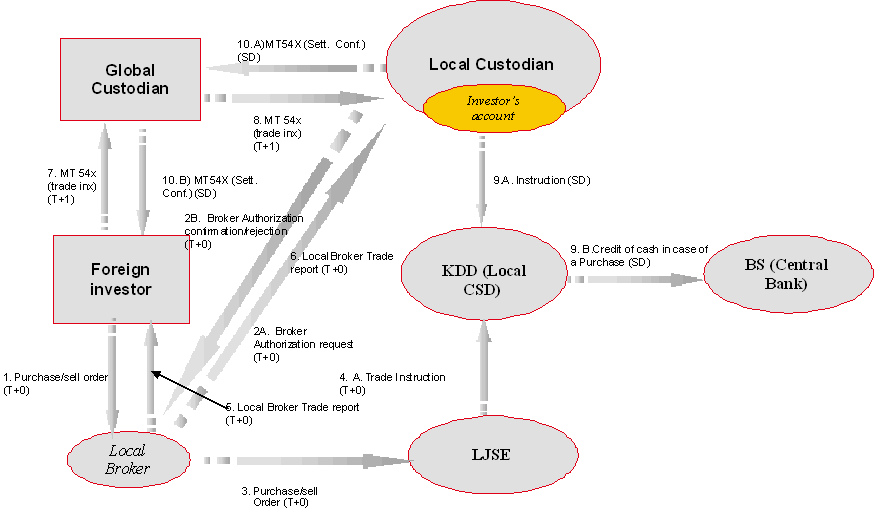
Book-Entry: The clearing and settlement for on- and off-exchange transactions is provided by the Central Securities Clearing Corporation (KDD). Cash settlement is done through cash accounts at Bank of Slovenia. Settlement is performed by means of book entry transfers and all KDD members have direct on-line access to the depository's settlement system, CRVP, which allows monitoring of trade settlement status. LJSE provides the central depository with all concluded trades at the end of the day. A trade, once concluded on LJSE, is binding for both parties and settlement on the respective participant accounts becomes mandatory (on the basis of the broker trade reports). For the purposes of settlement, cash is netted on multilateral basis while securities are settled on trade-by-trade basis. Securities transfers are processed within the KDD’s CRVP system and Target2Securities. Cash settlement is processed on the DCA cash accounts in TARGET 2 RTGS payment system. All systems are linked. Trading members on the LjSE are required to be participants of the KDD or have an agreement with the participant of the KDD which execute settlement of their trades on LjSE. The members of KDD, which are not banks, are obliged to conclude an agreement with the bank, which execute the cash settlement through the DCA cash account, on their behalf.

Brokers and custodians have entered into special agreements to transfer the settlement obligation from brokers to custodians. Under these agreements, trading on the LjSE is performed by using a special code, which enables automatic allocation of the settlement to custodian accounts within the KDD.

Prior to executing trades on the LjSE, brokers need to obtain authorization from the custodian. This obligation arises due to the above mentioned settlement procedure, which transfers the settlement obligations to the custodian.

The same settlement method applies to on-exchange block trades.

Partial settlement is not allowed for any type of LJSE trades and for OTC trades.

MATCHING PROCESS

On-exchange

Upon receipt of custodians’ confirmation of securities availability, brokers enter orders into the LjSE’s Xetra system. The system automatically matches bids and offers. Under the LjSE’s rules, matched trades become binding by 3:10 pm, on trade date (T).

The LJSE electronic trading system (Xetra platform) provides the central depository’s settlement system, CRVP, with all concluded trades after end of trading. The KDD blocks sold securities on sellers’ securities accounts and calculates each participant’s net settlement cash obligation on settlement date.

The broker confirms the trade execution to their client, and by close of business on trade date, notifies the local custodian by fax and/or email, of the trades executed for the local custodian’s clients.

Off-exchange


KDD participants send settlement instructions to the KDD and KDD sends them to the Target2Securities by settlement date 4:00 pm (by 6:00 pm for free of payment transactions). Then there is an automated matching process through the KDD's CRVP system and Target2Securities. Once matched, securities are blocked and the system allocates a reference number to the transaction for the purpose of the funds transfer. Unmatched settlement instructions remain at the KDD and Target2Securities for a period of 20 business days from the expected contractual settlement date before cancellation.

SETTLEMENT PROCESS

On-exchange

Contributions to the liquidity reserve fund must be paid by 9:15 am on T+1. By 1:30 pm, to KDD DCA cash account.

By 10:00 am on SD, local custodians are obliged to  execute cash payments in favour of the KDD’s DCA cash account in Target2. . The KDD checks cash receipts and sends instructions to Target2Securities at 10:15 am. Once executed the payments become final and irrevocable.

By 10:00 am on SD, sufficient securities should be in place to cover sale obligations. The KDD sends instructions to Target2Securities at 10:15. Transactions are settled in Target2Securities at 10:30 a.m. At 11:0 pm, the KDD commences with the transfer of securities in continuous batches through direct debit and credit entries to the accounts of the buyers and sellers. Securities transfers are irrevocable on execution. The local custodian can check the entry of securities through the KDD CRVP system.

The settlement confirmations are sent to the clients during the day (real time), latest until 5:00 pm.

In case a participant fails to meet its payment obligation by 10:00 am on SD, the KDD activates the liquidity reserve. If the liquidity reserve is insufficient, the guarantee fund will be used. In case the guarantee fund is insufficient, all KDD participants will be requested to contribute to the fund.

Off exchange

Settlements of on-exchange block trades and OTC transactions take place on a real time basis throughout the business day between 8:00 am and 4:00 pm. Following matching of the transaction in the KDD’s system and in Target2Securities, the purchasing party has until 4:00 pm to execute a payment order to the KDD’s DCA account in Target2, specifying the reference number allocated.

The KDD sends instruction to Target2Securities. After the settlement in Target2Securities is executed, the KDD instructs payment to the DCA of selling party and transfers the securities through the KDD’s CRVP system.


Short Selling

N/A Effective November 1, 2012, the relevant authority must be notified by investors of the short position of shares and government debt when the position reaches or falls below the levels specified in the regulation. The relevant authorities are the local Financial Supervisory Authorities (FSAs). 

The short positions of shares must also be disclosed to the public by posting information on the local FSA's website when a position reaches or falls below the specified levels. 

For full information of the new regulation and reporting requirements please visit the European Securities and Markets Authority website at http://www.esma.europa.eu/.

Turn-around Trades

LJSE allows but does not regulate turnaround trading. Debit positions on securities accounts are not allowed. There is no automated linking of trades. Only received securities are considered to be available for delivery.

Clearing Agents

KDD performs the functions of central securities depository, clearing agent and registrar in Slovenia.

Depositories

KDD performs the functions of central securities depository, clearing agent and registrar in Slovenia.

Bank for International Settlements (BIS) Settlement Model

BIS is an international organisation which fosters cooperation among central banks and other agencies in pursuit of monetary and financial stability. The Committee on Payments and Market Infrastructures (CPMI) uses three common structural approaches, or models, to categorise the links between delivery and payment in a securities settlement system.

For the settlement of LJSE trades there is mandatory settlement on T+2 where securities are settled on gross basis and funds are settled on net basis. Both transfers are final. This follows BIS Model 2 - Gross simultaneous settlement of securities followed by net settlement of funds, By 10:00 am on SD, local custodians are obliged to execute cash payments in favour of the KDD’s DCA cash account in Target2. The KDD checks cash receipts and sends instructions to Target2Securities at 10.15. Once executed the payments become final and irrevocable.

For OTC trades there is continuous against payment gross settlement of securities and funds. This follows BIS Model 1 - a system in which there is a simultaneous transfer of securities and associated funds from the buyer to the seller. All transfers occur on trade-by-trade (gross) basis with all transfers made via book entry. All transfers are final. Following matching of the transaction in the KDD’s system and in Target2Securities, the purchasing party has until 4:00 pm to execute a payment order to the KDD’s DCA account in Target2, specifying the reference number allocated.

Registration Process

Book-Entry: Securities are held in the depository in the name of the beneficial owner or in omnibus (fiduciary) accounts. 

Physical: No physical securities exist in Slovenia.

Registrar

The KDD performs the functions of central securities registrar.

Registration Period

Registration occurs automatically on settlement date.

Risk

Disclosure Requirements

Share holdings may be required to be disclosed by the beneficial owner, particularly when holdings reach or exceed prescribed disclosure limits. Investors must ensure that they comply in full by reporting such holdings to the appropriate organisations for this market, within the timeframe required. If you have any questions regarding this issue we encourage you to consult your legal counsel. 

Failure to comply with reporting requirements may lead to penalties and/or other sanctions.

The below special requirements for acquisitions are valid for both resident and non-resident investors.

  • The Ministry for Culture has to issue an approval when an investoracquires 20% of the voting rights in a public daily newspaper
  • SEC has to issue an approval when an investor acquires 10%, 20%, 33% and 50% of the voting rights in a brokerage house.
  • SEC has to issue an approval when an investor acquires 10%, 20%, 33% and 50% of the voting rights in an asset management company.
  • The approval of Bank of Slovenia is required in case of acquiring 10%, 20%, 33% and 50% of the voting rights in a Slovenian bank.
  • The approval of the Agency for Insurance Supervision is required in case of acquiring 10%, 20%, 33% and 50% of the voting rights in a Slovenian insurance company.

Only for investments into military industry the foreign investors needs an approval of the government.

In general, investors are obliged to provide disclosure if trough an acquisition or sale the thresholds of 5%, 10%, 15%, 20%, 25%, 33.3%, 50% and 75% of the voting rights are cross. 

The Securities Market Agency published a Decision on amendment of the Decision on information related to threshold reporting (valid as of 16 december 2016). The Decision was adopted in line with the Market in Financial Instruments Act (MiFIA) under Article 127 (Provision concerning the information on major holdings). The Decision redefines the detailed criteria for the relevant date of change of holdings in an public company as a result or corporate actions of such public company with regard to the shareholders’ obligation to inform a public company on the change in major holdings, as well as deadlines and form for reporting (P-DEL) of the respective change to the public company and the Securities Market Agency. When a shareholder, who is a holder of stock options or person liable for reporting, acquires and disposes within the same day, the obligation to report a change in a significant portion of it occurs only if the result of the acquisitions and disposals at the end of each trading day such, that reaches or exceeds or falls below this threshold. The moment of acquisition or disposal (change), is a date of the transaction, pursuant to which the shareholder liable for reporting or holder of financial instruments acquired or disposed of shares and reached, exceeded or fell below a particular threshold. In case of a corporate actions of a public company, a moment of acquisition or disposal (change) of shares or financial instruments shall be considered the date when the transaction (in case of subscription and payment of shares) shall become effective. The shareholder or person responsible for reporting is obliged to notify the Securities Market Agency and the public company by sending the form (P-DEL) as regulated in the Decision as soon as possible and no later than the fourth trading day after the day:

  • When he learned about the acquisition or disposal of shares or the possibility to exercise voting rights, or he would become aware of it, regardless of when they have the legal effects of the acquisition or disposal of shares or the possibility of exercising the voting rights, or
  • When he became aware of corporate action.


The basis for establishing a major holding consists of all holdings of a public company with the voting rights and shares the exercising of which is limited by law or articles of association. The Decision abolishes the obligation of the public company to publish the change of major holdings (in case of own shares), if it receives the notification from the management or supervisory body of such public company (the obligation to publish the change of major holdings, if notified by the shareholders or any other obligor for notification, remains unchanged). The same disclosure requirements apply should the percentage of ownership fall below or get over the thresholds. The issuer must publish information on breaches of threshold in one of the local daily newspapers and/or the LjSE information system, SEOnet. The Law on Takeover requires mandatory public takeover bid when 33% stake in a company in reached. The reporting requirements and mandatory public takeover apply for residents and for non­residents.

Effective July 3, 213, the following amendments to the Slovenia Takeover Act was published:

  • A person that has acquired a takeover threshold of 1/3 of the voting rights in the target company with the intent to execute a financial restructuring of this company and to assure its capital adequacy or its long term ability to pay, before the procedure of insolvency is started, is exempt from the obligation to make a takeover bid, in case this person acquires an approval from the SMA beforehand. The exemption from takeover bid in this case is valid for 5 years after such securities are acquired
  • A person, that is exempt to make a takeover bid as described above, becomes obliged to make a takeover bid if the next acquisition of the securities of the same company occurs before a 5 years period has expired (counting from the day of the first acquisition of the securities) under the condition that such person still exceeds the takeover threshold in such a company

With regards to omnibus (fiduciary) accounts, the obligation to perform threshold reporting lies with the beneficial owner or with the third party which exercises the voting rights on behalf of the beneficial owner (according to the third party's own will).

Buy-Ins

On T+2, the settlement date, by 11:00, KDD verifies that participants with selling obligations have sufficient securities in their accounts to meet their obligations. If securities are not in place, a request for advanced payment is sent to a member-seller which did not fulfil its obligations. The seller has a possibility to cover the position up to 9:00 on SD+1. If the position is not covered by then, KDD initiates a buy-in through the LJSE at 9:30 on SD+1. KDD has three days to execute the buy-in on LJSE. If KDD is not able to execute the buy-in on LJSE, it is executed during a public auction. The trade is executed on behalf of KDD's fiduciary account.

In addition to the cost of the buy-in, the defaulting participant will be subject to an additional fine, equal to 20% of the cost of the securities purchased by KDD.

If the seller fails to deliver the securities until 11:00 on the trade's original settlement date, the buying participant is notified. In the notification KDD advises the buying participant of the future actions that will be taken:

  • buy-in
  • cancelation of the trade.


If the buyer chooses to cancel the trade, the selling participant is penalised with an amount equal to 50% of the original trade. 

KDD has advised that buy-in (and sell-out) arrangements have not been used to date. 

Buy-in/Sell-out procedures are not applicable to block trades or over-the-counter (OTC) transactions.

Securities Lending

KDD's General Business Rules foresees a securities lending system, which should be incorporated in CRVP on a securities pool principle, however such an institutionalised lending system does not exist currently and lending is performed on a bilateral basis.
At the end of the trade date (T+0) each member knows what their exact position will be in two days when final settlement occurs. Therefore, a member can promptly borrow the missing securities. To ensure settlement without problems, sold securities have to be available by 11:00 on T+2. 

Compensation Fund

In order to provide protection from a defaulting member, the KDD has established the Guarantee Fund and the Liquidity Reserve Fund which are made up of contributions from their members. 

The liquidity reserve fund is a sort of prepayment of the member's net obligation from trades executed on LJSE when this obligation exceeds a certain amount. The respective KDD member is obliged to contribute to the liquidity reserve fund when its daily net cash obligation exceeds the amount equal to 25% of the initial principal of the guarantee fund plus its additional contribution. The liquidity reserve fund obligation is calculated for each individual member on a daily basis by KDD up to 16:45 on T and is due by 9:15 on T+1.

The guarantee is activated when the settlement member does not fulfil its net cash obligation from LJSE trades. Each member of KDD is obliged to contribute to the guarantee fund as follows:

  • basic annual contribution determined by the volume of trades executed on LJSE during the previous year, same for each member
  • monthly additional contribution determined individually for each member based on the volume on net obligations from trades executed on LJSE during the previous months


The Central Bank informs KDD on the settlement date if any member cannot cover its cash obligations. KDD immediately debits the guarantee fund and credits its clearing account for the shortage. KDD then initiates the process for reimbursement of the guarantee fund and may place in line the securities of the defaulting member. If the guarantee fund resources are not sufficient, all members would have to make additional contributions.

Anti-Money Laundering

The new Anti Money Laundering and Terrorist Financing Law came into effect on 21 July 2007. Exceptions are parts of the Law, which define obligations of responsible legal entities and other organisations for the prevention of money laundering and terrorist financing activities, which became valid from 21 January 2008 and 21 November 2016. The most important changes in the amended law are as follows: 

  • Implementation of Directive 2005/60/EC on the prevention of the use of the financial system for the purpose of money laundering and terrorism financing and Directive 2006/70/EC on the definition of "politically exposed person" and the technical criteria for simplified customer due diligence procedures and for exemption on grounds of a financial activity conducted on an occasional or very limited basis.
  • Clear and extended definition of legal entities, responsible for the measures for detecting and preventing money laundering and terrorist financing. The extended list includes also audited companies, tax advising companies, companies, which provide fiduciary and enterprise services (account opening, etc.).
  • Identification of a client shall be obligatory before a business relationship is established and for every transaction or connected transactions in an amount of EUR 15.000 or more (according to the currently valid Law EUR 20,864)
  • Identification of clients can be done by a third party if this party is a financial institution - a bank, a branch or a daughter company of the bank, a brokerage house, branch or a daughter company of the brokerage house, an investment fund manager, branch or a daughter company of the investment fund manager, founders and managers of pension funs, an insurance company, branch or a daughter company of the insurance company, a notary with seat in EU or EEA country (Norway, Liechtenstein, Iceland) , or in a third equal country.
  • A more elaborated definition of the legal owner in different legal organizational forms (company, institution, foreign funds and foreign institutions, entrepreneur, etc.)
  • Further information about the legal owner in case of a standard and comprehensive procedure: name, permanent or temporary address, date of birth, nationality and level of shareholding or other means of control.
  • Third party identification:
  • - The data concerning client identification needs to be provided immediately, and other documentation can be provided upon request of the Bank
  • - Client identification within the group: Institutions committed to follow the AML Act, and are part of a group carrying out its policies and procedures, shall relate to the mechanisms to detect and prevent money laundering and terrorist financing defined in the act.  Policies and procedures of data protection and information shall be  shared within the group.
  • The abolishment of the List of Countries by Geographical Risk Area issued by Bank of Slovenia. Instead, a new list, issued by the European Commission, will be taken into consideration: The Slovene Office for Money Laundering will publish the list on web page:  http://www.uppd.gov.si/si/.
  • Slovene AML Office was granted powers with inspection and therefore will exercise, on the spot, control of all institutions committed to following the AML Act. At that point, the Office will cooperate with Bank of Slovenia and Securities Market Agency (SMA). All banks will be under the supervision of these three institutions.
  • Additional penalties for severe violations (intention, greed, repetition) have been approved. The penalties will range from EUR 12,000 to EUR 120,000 and in the severe cases, can go up to EUR 5 mn for Financial Institutions or 10% of total annual turnover in the preceding business year.
  • Disclosure related to control and identification of violations (including information on the offender): Supervisory authority (AML office, Bank of Slovenia and SMA) can publicly disclose information in relation to the control measures and sanctions for offenses that were identified and imposed.

The list of third equal countries issued by the Slovenian Ministry of Finance includes the following countries: Australia, Federal Republic of Brazil, Canada, Hong Kong, Japan, Mexico, Singapore, Switzerland, Republic of South Africa, USA, South Korea and India. In a case, that the client is identified by a financial institution, as prescribed above, the bank can also accept copies of the documentation, which was used for identification of the client, although the documentation may differ from the documentation prescribed by Slovenian Law. The provided documentation should though state:

  • company name and seat,
  • legal status,
  • proof that the client is entitled for simplified procedure.

Identification by third party cannot be done if client is a legal person, which is not allowed to perform a commercial or manufacturing activity in the country, in which it is registered, or if a client is a fiduciary or similar company of foreign law with unknown owners and managers.

The AML Law prescribes two kinds of identification of the clients:

  • identification without "face to face" for clients entitled to simplified procedure
  • "face to face" identification for clients in a case of standard and comprehensive procedure

There are three different account opening procedures and requirements for different types of investors:

  • simplified procedure
  • standard procedure
  • comprehensive procedure

Simplified Procedure:
The simplified procedure is applicable to:
Institutional Underlying Clients (banks, saving banks, posts, investment fund managers, founders and managers of pension funds, pension fund companies, brokerage houses, insurance companies) from countries specified in the enclosure List of Countries by Geographical Risk Area for simplified procedure.

  • State authorities, local communities, public agencies, public funds, public institutions, chambers of commerce located in Slovenia
  • Joint Stock Companies which securities are listed on an organised market in countries specified in the enclosure for simplified procedure including Serbia, Turkey and Macedonia
  • EU Institutions such as: European Central Bank, European Investment Bank, EU Council, EU Parliament, EU Commission and others. Clients looking to open an account under the simplified procedure must present evidence that it is entitled to that.


Standard Procedure: 
The standard procedure is applicable to all other clients, which do not fulfil the criteria for applying the simplified identification procedure.
Clients looking to open an account under the standard procedure must provide acceptable proof of its ownership structure (in the form of certificate of registration or extract from court or other public register of companies or other official document), which shall disclose the final beneficiaries (end individuals) who own, control or otherwise exercise control over the management of the client legal entity, including through bearer share holdings, other than for a company listed on a regulated market that is subject to disclosure requirements consistent with the EU legislation or subject to equivalent international standards. Data on the name and surname, the permanent or the temporary address and the date and the place of birth of these end individuals with share of more than 25% of the voting rights shall be disclosed.

Comprehensive Procedure:
Comprehensive procedure is applicable for:

  • For legal entities if beneficial owner, legal representatives or authorized person is politically exposed person.
  • Clients from countries with higher possibility of money laundering. Please see the list in the enclosure List of Countries by Geographical Risk Area for comprehensive procedure.
  • If beneficial owner, legal representatives or authorized person of legal entity is a national or resident of the country with higher possibility of money laundering.


A politically exposed person is any natural person (individual, statutory representative or authorized person) who is or has been entrusted with prominent public function in the previous year and resides in any other country than Slovenia, including its immediate family members and close associates. 

The list of countries is published on web page of Office for Money laundering prevention only in Slovene language:http://www.uppd.gov.si/. The list is prepared in line with FATF, other international organizations and Slovene specifics

Clients looking to open an account under the comprehensive procedure may be required additional documents, defined on case-by-case basis, including disclosure of the source of funds, which are or will be the subject of the business relationship or transaction.

List of countries by geographical risk area

Simplified Procedure

Australia

Finland

Lithuania

South Korea

Austria

France

Malta

Spain

Belgium

Germany

Netherland

Sweden

Brazil

Hong Kong

Norway

United Kingdom

Canada

Iceland

Poland

USA (with exception of Delaware, Nevada, Wyoming)

Croatia

Ireland

Portugal

Denmark

Italy

Slovenia

Estonia

Japan

South Africa


Standard Procedure

Barbados

Greece

Namibia

Switzerland

Benin

Grenada

New Zealand

Taiwan

Bulgaria

Hungary

Romania

Uruguay

Cape Verde

India

Saint Lucia


Chile

Lesotho

Saint Barthelemy


Czech Republic

Macedonia

Saint Vincent and the Grenadines


Georgia

Mauritius

Slovakia


Comprehensive Procedure

LIST OF COUNTRIES BY GEOGRAPHICAL RISK AREA is subject to change in accordance to the local legislation. New valid List of Countries by Geographical Risk Area is used when new business relationship is established or when Custodian who is already our client is in process of opening new securities accounts. 

Documentation Required

Documents required applicable for the three procedures

  • Account-opening instructions
  • Certificate of Registration or Extract from Court or other public Register of companies or other official document issued by authority institution.
  • Specimen Signature List or Client's List of Authorised
  • Data on Legal Representatives (Top Management) - A certificate from the trade registrar, the company's statute or any similar official document that list the persons that can legally represent the company, is required in order to support the eligibility of the signatories on the Client Evidence Sheet. As an alternative, a notarised letter of incumbency carrying the notary affirmation of the signor authorisation, an annual report, an establishment act, articles of association or minutes from the Standard assembly may suffice.
  • In case that data on Legal Representative are not required by AML legislation in a domicile country of Custodian, data on a person opening the security account (an authorised person) are sufficient. As a proof the Custodian is obliged to provide English translation of AML legislation.
  • Power of Attorney (notharized)
  • Broker Authorisation and Acknowledge of Settlement Procedure

 Copy of ID document or passport of Legal Representative and Authorised person, who signed the Client Evidence Sheet

The copy isn’t necessary required at the account opening but upon request. If the copy isn’t provided within 1 month after request, the bank will block the security account and will not execute any transactions, payments and corporate actions.

Simplified procedure:

  • Proof, that a company is entitled for simplified procedure, if this is not proved by the certificate of registration
  • Client's Evidence Sheet for simplified procedure

Standard procedure:

  • Client's Evidence Sheet for standard procedure
  • Ownership Structure

Comprehensive procedure:

  • All documents documents as for standard procedure are required
  • Additional information and documentation (for politically exposed persons the source of funds which are or will be the subject of business relation or transaction shall be disclosed) Additionally if not already published in the Bankers Almanach, bank type entities must provide a completed anti-money laundering questionnaire based on the Wolfsberg Group designed template. For politically exposed persons the source of funds, which are or will be the subject of the business relation or transaction, shall be disclosed.

RENEWAL OF DOCUMENTATION:

The renewal of documentation (except for the Power of Attorney and the Broker Authorization and Acknowledgement of Settlement Procedures in Slovenia) is required for active security accounts on a periodic basis with the following frequency:

  • for Comprehensive procedure (high risk client or those with higher risk classification)- every two years;
  • for Standard procedure (medium risk customers) - every three years;
  • for simplified procedure (low risk customers- every five year.

If there were no transactions and assets on the securities account more than 12 month, such securities account is no longer listed as active account. In accordance with the Slovene law and internal banking policies, bank will not allow reactivation of dormant securities accounts in its books unless all documentation, required under the Slovene Know Your Customer and Anti-Money Laundering legislation, is in a place. Consequently, in order to ensure future trading activity is not impacted, UCB Slovenia requires the review of documentation for dormant account every five years.

Foreign Ownership

Market Entrance Requirements

For clients serviced out of certain locations this is an FII market. Please refer to the Terms & Conditions for Global Custody or contact your RBC Investor Services' Client Manager before making portfolio investments.

Investment Restrictions

Non-residents can invest freely in all types of business undertakings (subject to the restriction elaborated above related to investments in newspapers, brokerage houses, asset management companies, banks and insurance companies) and foreign investments into the military industry require Government approval.

Repatriation Policy

Income, capital and sale proceeds can be repatriated freely.

Cash

FX Regulations

Settlement is done in EUR and FX can be done against any currency.

Payment Systems

Since 1 January 2007, when EUR was implemented, all payments have been executed in EUR only and Slovenia is directly connected to TARGET2. All transaction account numbers in Slovenia have the IBAN structure and all banks are obliged to use IBANs in all domestic and cross-border transfers.

The following payment systems operate in Slovenia:

  • TARGET2-Slovenija operates on the single shared platform of the TARGET2 system and in formal legal terms is a system controlled and operated by Bank of Slovenia and intended primarily for the settlement of large-value payments and time-critical payments in euro. The settlement of the cash part of securities settlement is done in TARGET2 through cash accounts opened at the Central Bank.
  • Single entry point (SVT), which allows banks and savings banks to participate indirectly in the STEP2 XCT system, operated by EBA Clearing, which facilitates the processing of cross-border payments of up to EUR 50,000 and is intended for the processing of mass payments that can be processed entirely automatically.
  • SEPA external credit transfers (SE PA ECT), which allows Slovenian banks and savings banks to participate indirectly in the STEP2 SCT system, operated by EBA Clearing, and is designed for the processing of SEPA credit transfers with no limit on payment value.
  • SEPA internal credit transfers (SEPA ICT), which is a multilateral netting payment system allowing the execution of internal SEPA credit transfers.


The supplementary payment infrastructure in Slovenia comprises systems for the interbank settlement of retail payments arising from card-based payments and cash withdrawals.

Overdraft Permitted

Overdrafts are permitted.

Entitlements

Dividend Process

Dividends are generally payable on an annual basis. Dividend distributions are announced at the annual general meeting of the issuer.

Income collection process:

  • New: CSD will notify its register members on the income payments. Dividend announcements are done when the shareholder meeting is announced (once per year)
  • In addition, UCB Slovenia will track other official announcements (newspapers, web pages of issuers, AJPES, SEO net, CRVP GUI).
  • Checking with issuer regarding the exact payment date and sending to them the list entitled client with related cash account.
  • MT564 notification is sent to the clients within 24 hours of when the announcement is made on the market.
  • AFI procedure – In case the client has obtained the Authorized Intermediary status, in addition to the MT564 notification, an Excel is sent from which is seen we send out an Excel (Report on the receipt of income). The report identifies the securities accounts entitled for income payment. The AFI than completes it and sends it back to us. Zagrebačka Banka d.d. has not obtained the AFI status.
  • On pay date, tax rate is reduced based on AFI procedure. In case of non-AFI, the full tax rate is deducted.
  • On PD the issuer books the cash at CSD. The CSD than books the cash income in gross amount to UCB Slovenia DCA account. After the booking on the UCB Slovenia DCA account, members allocate the cash to a cash accounts opened at UCB Slovenia.
  • Income is booked
  • When the income is booked on the cash accounts at UCB Slovenia, MT566 confirmation of the receipt of income is sent to the clients.

In a case, that payment date for dividends is not defined on AGM, the dividends should be paid within 15 days after AGM. If record date is not defined on AGM, it is according to the Law 2 days before entitlements are due. Usually the issuer of securities specifies these dates, e.g.: The record date (date, when shareholder has to be registered in shareholder book at KDD in order to receive dividend payment) is prescribed by issuer in the AGM announcement. The entitlement is determined according to traded position on ex date. The KDD provides the issuer with the records of the registry on record date. The dividend payment has to be made by the issuer to the account of the local custodian bank, which allocates the payment to the individual accounts of foreign investor. There are no restrictions for repatriation of dividends for foreign investors.

With February 2017 when also the important days for CA were defined according to CAJWG/CASG international standards for CA, the PD was defined as RD+1. The CAJWG/CASG standards are according to valid CSD rules not biding for the CSD. Dividend payments are usually done within 30 to 60 days after a resolution on capital distribution is adopted on AGM. On the AGM a payment period or last payment date are defined. According to the new procedure with CSD from February 2017 (please see above) issuers can also define the exact PD on the AGM.  Shareholders' accounts are credited with the dividend amount only after actual receipt from the CSD who receives the cash from the issuers.

Dividend Payment Frequency

Annual

Interest Payment Frequency

Annual or Semi-annua. For the distribution of interest to the account holder, the same rules apply as for the distribution of dividends. In case, that payment date for interest and principal for fixed income is not defined, the entitlements should be paid within 2 working days after the end of the amortisation period.

Ministry of Finance (MF) performs the functions of the principal paying agent for government bonds and T-bills. It pays interests and repays principal to investors through CSD.

MF transfers the interest to the CSD (according to the new CSD rules) who than pays the interest/principle to the members (local custodians). The amount is credited on the custodian account and with the same day value booked on clients' cash accounts. The payment is performed on ACTUAL/ACTUAL basis. Repayment of principal amount of government bonds and T-bills is effected in accordance with the procedure of interest payment.

Interest Accrual Rate

Actual/Actual or Actual/360

Corporate Actions

Common Events:

Although the market has little experience in corporate actions, right issues, shares splits and stock dividends are legally recognised events. 


Common mandatory events: stock dividends, final redemptions, interest payments, mergers and stock splits.
Common voluntary events: AGM/EGM, purchase/tender offers, repurchase offers and subscription offers

Rights Tradable:

No

New shares and Exercised Rights:

Not applicable

Additional Information

Rights are neither tradable nor transferable and can only be exercised. According to the New CSD rules valid as of February 2017. CSD notifies the members (via e-mail) on a particular CA after it receives the information from the members issuers. With February 2017 the important days for CA were defined according to CAJWG/CASG international standards for CA. Following CA on flow are executed by CSD: transformations (pari-passu), maturity, redemptions, exchange of ISIN and  Payment of fractions, Market claims (distributions). Buyer protection (elective CA) is not executed by CSD. Following CA on stock are done by CSD: securities issuance, voluntary and mandatory reorganisations, distributions.

Starting from April 4, 2018, the Slovenian CSD started providing notifications on General Meetings of Shareholders to its members, in addtion to information on corporate actions and income payments.

Protection of Rights

Equities, rights and entitlements are calculated based on traded positions on ex-date.

Proxy Voting

Foreign Investor Restrictions

In order to vote at a general meeting, the physical attendance of the shareholder or proxy is required. Shareholders are required to sign a proxy card when appointing a proxy agent or the company's Articles of Association may prescribe that shareholders may participate and vote in the meeting by electronic means or vote by mail prior to the meeting (in which case certain security and other conditions must also be respected (i.e., identification of individuals, etc.)) - that, however, has not been adopted by any local company so far.

Shareholders of public companies can appoint a proxy by electronic means, while at the same time they must observe the provision which applies to all shareholders (written form of authorization). The AoA of a public company must ensure that shareholders send the notification about appointing a proxy by electronic means.

The single record date is prescribed for all companies. Only shareholders which are entered in the Central register of securities at the end of the fourth day before the GMS may participate and vote in the GMS. Record date is a specified date prior to the GMS which provides the rights of shareholders to participate in the GMS and to vote.

Shares Blocked

Shares are not blocked in the local market for the purposes of proxy voting

Meeting Notices/Agendas

Annual general meetings shall be announced in at least one daily widely circulated newspaper at least 30 days prior to the meeting, or via LJSE information system and on the company's website. Members issuers have to immediately notify the CSD on the convocation of GM of shareholders, extending the agenda of the meeting, resolutions adopted on the GM (according to the new CSD rules.

Meeting Outcome

Available upon request

Company Reports

Available upon request

Power of Attorney

Required, specific for each meeting

Other

None

Taxation

Dividend Tax Rate

15% for non-resident legal entities and 25% for non-resident individuals, subject to reduction based on DTT.

Effective January 1, 2020 the WHT rate on dividends increased from 25% to 27.5%. The WHT tax rate for unlisted corporate bonds will be 27.5% and 0% for government and listed corporate bonds.

Withholding Tax, Cash Dividends and Stock Dividend:
Entities: General withholding tax rate is 15%* or according to DTT, if beneficial owner is not disclosed then 25% (which is the maximum tax rate – valid from 1.1.2013, before it was 20%).

Individuals: General withholding tax rate is 25% or according to DTT, if beneficial owner is not disclosed then 25% (which is the maximum tax rate – valid from 1.1.2013, before it was 20%).

  • * The tax shall not be calculated, withdrawn and paid on dividends which is paid to a non-resident entity, who is resident of the EU and/or EEA member states, and is a person liable for tax on income in the country of residence, on the condition that this is not an income paid to a permanent establishment of that non-resident in Slovenia and if that non-resident cannot claim the tax in the country of residence and the purpose of the transaction is not tax avoidance.
  • * The tax shall not be calculated, withdrawn and paid on income referred to interest and dividends which was paid to non-residents – pension funds, investment funds and insurance undertakings authorised to implement the pension scheme if they are residents of an EU and/or EEA member state and provided that the income was not paid to a permanent establishment of this non-resident in Slovenia and the non-resident cannot claim the tax in the country of residence. Exemption from taxation or taxation of income of these taxpayers in the country of residence at a 0 % rate shall also be deemed to be inability to claim tax.

But tax shall be calculated, withdrawn and paid for payments to countries with which no exchange of information is provided that would enable the monitoring of taxation or non-taxation of income."


Higher Tax Rate on Capital Income According to the amendments to Personal Income Tax Act (Zdoh-2V), which were adopted by the National Assembly on 23 October 2019, tax rate on capital income will be increased from 25 % to 27.5 % effective with 1 January 2020.
The tax rate increase will apply for:
▪ resident individuals for the following income: - Dividend payments - Interest payments - Capital gains
▪ undisclosed non-residents* having their financial instruments on omnibus accounts via foreign intermediaries (for which the highest tax rate applies) for the following income: - Dividend payments - Interest payments *If the foreign intermediary has AFI (Authorized Foreign Intermediary) status and beneficial owners are disclosed, taxation according to the DTT applies.

Interest Tax Rate

Non-resident investors are subject to 0% withholding tax on interest income subject to the below qualifications. 

The 0% exemption is not valid for the following corporate bonds:

  • convertible bonds, which have an embedded right or possibility to be converted into equities, and
  • bonds, issued in line with the 2001 Denationalisation Act


The above are still taxed at 15% for legal entities and 27.5% for individuals from January 2020

The 0% exemption with respect to individuals does not apply to government bonds, which have not been issued for budget financing - a tax rate of 20% is applied instead.

Withholding Tax, Interest on Corporate Bonds and Interest on Government bonds/ Treasury Bills:
Entities: General withholding tax rate is 15%** or according to DTT, if beneficial owner is not disclosed then 25%. Government bonds and most corporate bonds*** are taxed with 0% even if beneficial owner is not disclosed (From 1.1.2013 not disclosed or maximum tax rate is 25% before it was 20%).

Individuals: General withholding tax rate is 25%**** or according to DTT, if beneficial owner is not disclosed then 25%. Most Government bonds***** and most corporate*** bonds are taxed with 0% even if beneficial owner is not disclosed (From 1.1.2013 not disclosed or maximum tax rate is 25% before it was 20%)

** Under domestic law, interest paid by resident banks to non-resident entities is not subject to withholding tax unless the recipient of the interest is resident in a low tax jurisdiction. Low-tax jurisdictions are non-EU jurisdictions where the general or average nominal tax rate is lower than 12.5%. 

The tax shall not be calculated, withdrawn and paid on income referred to interest and dividends which was paid to non-residents – pension funds, investment funds and insurance undertakings authorised to implement the pension scheme if they are residents of an EU and/or EEA member state and provided that the income was not paid to a permanent establishment of this non-resident in Slovenia and the non-resident cannot claim the tax in the country of residence. Exemption from taxation or taxation of income of these taxpayers in the country of residence at a 0 % rate shall also be deemed to be inability to claim tax. 
But tax shall be calculated, withdrawn and paid for payments to countries with which no exchange of information is provided that would enable the monitoring of taxation or non-taxation of income.

*** CORPORATE BONDS: Under domestic law, there is an exemption from withholding tax for interest payments arising from debt securities issued by a company incorporated in Slovenia if:
1. such securities do not contain the option to be converted into equity securities and they are not issued in line with a Denationalization Act; and
2. They are admitted to trading on a regulated market or are traded in a multilateral trading system in an EU member state or in an OECD member country.

**** For disclosed non-resident EU individuals the WTH is exempt which has to be reported according to Savings Directive. For disclosed non-residents non EU individuals the WHT is deducted.

***** GOVERNMENT BONDS: Tax rate is 0% with exemption of government bonds which are not issued for budget financing.

Capital Gains Tax Rate

An individual, resident of Slovenia is subject to capital gain tax. In general, capital gains derived by non-resident individuals are not taxable in Slovenia. However, capital gains are taxable (by assessment), if they are derived from the disposal of:

  • a "prevailing share", defined as a shareholding in a legal entity, which represents an ownership, voting rights pr single class of shares of 10% or above at any time during the last 5 years
  • shares or other participation rights in a Slovenian legal entity if more than 50% the value of the entity stems from immovable property.


In general, the taxable amount of taxable capital gains is determined as the difference between the sale price and the purchase price, reduced by prescribed costs. The sale price must be at least the market value of the property. The general tax rate is 25%.  Capital gains: The tax rate is reduced each 5 years of holding period:

  • First 5 years of holding period:         25 %
  • 5 – 10 years of holding period:         20 %
  • 10 – 15 years of holding period:       15 %
  • After 15 years holding period:       0 %.

Consequently, any gains are exempt after a 15-year holding period.

Capital gains, acquired by a resident of Slovenia, which is legal entity, are included as an ordinary income and taxed accordingly. However, only 50% of the capital gains are taxed, provided that the shareholder has at minimum 8% of the voting rights for at least six months and that minimum one person was employed in the company full time. The rule though cannot be applied if the capital gains are derived by participation in companies, which have seat or effective management in "tax heavens". If an exemption from capital gains taxation applies, the amount of 5% of the exempt capital gains is non-tax-deductible expense.

Capital gains derived by non-residents are subject to corporate income tax under the general rules if they are attributable to permanent establishment. In other cases, although capital gains are defined as income with source in Slovenia, the law does not provide rules to impose tax on such capital gains (no assessment or withholding system exists).

Tax Treaties

Austria
Albania
Armenia
Azerbaijan
Belarus
Belgium
Bosnia & Herzegovina
Bulgaria
Canada
China
Croatia
Cyprus
Czech Republic
Denmark
Estonia
Finland
France
Germany

Greece
Georgia
Hungary
Iceland
India
Israel
Italy
Ireland
Iran
Latvia
Lithuania
Luxembourg
Macedonia
Malta
Moldova
Netherlands
Norway
Portugal

Poland
Qatar
Kazakhstan
Korea (South)
Kosovo
Kuwait
Romania
Russia
Serbia / Montenegro
Singapore
Slovakia
Spain
Sweden
Switzerland
Thailand
Turkey
Ukraine
UAE
United Kingdom
United States
Uzbekistan

Stamp Duty

None

Other Taxes

None

Holiday Calendar

Slovenia Holiday Calendar

Local Websites