KAZAKHSTAN

Updated as at November 24, 2022


Market Account Opening Requirements

RBC IS operates an omnibus account structure in this market.
 
For further information or support around accessing this market, please contact your RBC IS representative.

Market Statistics

Currency Kazakh Tenge (KZT)
Time Zone GMT +5 (+6) / EST +11
Kazakhstan Stock Exchange

  Market Capitalisation

Total capitalisation of KASE USD 80.2 billion

  Number of Listed Issues

Number of Firms Listing Equity: 135 (on KASE)

  Average Daily Share Volume

835

  Average Daily Trade Value

USD 76.4 million 

 (Figures as per January 2021, unless otherwise stated)

Market Infrastructure

Exchange(s)

The Kazakhstan Stock Exchange (KASE) 
The KASE was incorporated and registered with the Ministry of Justice on December 30, 1993 as a non-commercial, self-regulated, closed joint stock company. There were 57 shareholders comprising of banks and financial institutions as at April 1, 2013. Regional Financial Center of Almaty JSC is the largest shareholder. Shareholders include banks, brokerage firms, asset management companies, pension funds and other professional financial institutions. 

KASE is governed by the National Bank of the Republic of Kazakhstan (NBK). It is self-regulated through a set of regulations and rules approved by the NBK. KASE is responsible for the regulation of its member companies in accordance with its rules and regulations. It also ensures that listed companies comply at all times with KASE listing requirements and corporate disclosure policy. 

The government and control of the KASE is vested in the Exchange Council comprising of 16 members including senior bankers and brokers as well as the Exchange President, representatives of the Agency and the Central Depository.

Trading System
  • Kazakhstan Stock Exchange (KASE)
  • Central Securities Depository (CSD)
Trading Hours

KASE

Monday to Friday

11:30 - 17:00

CSD

Monday to Friday:

DVP trades 09:30 - 17:00

FOP trades 09:30 - 17:00


Security Identifiers

NSIN (National Securities Identification Numbers) codes conferred by the NBK are used. The code was developed in accordance with the internationally accepted standards and the structure of this code is very similar to the ISIN. There are twelve characters (alpha-numeric) in NSIN as in ISIN.

ISIN codes are not fully used in the Kazakh market although the CSD has already started issuing ISINs.

Regulatory Bodies

The National Bank of Kazakhstan 
The National Bank of Kazakhstan (NBK) is the central bank and also acts as the primary regulator of the banking industry. NBK licenses and supervises commercial banks operating in Kazakhstan. NBK conducts inspections of Kazakhstan banks and local branches of foreign banks. NBK also regulates foreign exchange, money markets and credit policy. NBK is fully independent in the execution of its functions within the limits of its authorities provided by the laws and other legal norms and reports to the President of the Republic of Kazakhstan. The NBK acts as the primary regulator of the banking industry and responsible for operating Kazakhstan’s payment system, the Kazakhstan Interbank Settlement Centre (KISC).

The activities of the NBK are regulated by the presidential decrees "On The National Bank of the Republic of Kazakhstan" and "On Banks and Banking Activities in the Republic of Kazakhstan", as well as by other regulations, presidential decrees, and international agreements ratified by the President.

Agency on regulation and development of financial market
On January 1, 2020, the new regulator “Agency on regulation and development of financial market” (Agency) operates in Kazakhstan and regulates the financial market. It regulates banking activity, securities market, insurance market. This regulator is self-governing entity and reported to the President of the Republic of Kazakhstan. This Agency is funded from the government through republic budget. 

Instruments

Equities:

Common shares, preferred shares

Debt:

Corporate debt, government bonds

Money Market:

T-bills

Physical:

None

Other:

Foreign currencies, derivatives


Form of Securities

All securities are held in dematerialised form both at CSD and Registrar.

Board Lots

Equities:

There are no board lots in the market, all securities are traded in units

Debt:

As above


Price Variations

Equities:
According to the KASE's rules, equity price variation is allowed up to 30% from average weighted price of this equity for the trade concluded on the KASE by method of direct trade. Any price variation over 30% will lead to suspension of trades, and this trade will be considered as executed with the purpose to manipulate prices.

Corporate bonds and government bonds:
Variation is allowed up to 3% from average weighted bond price. Otherwise it is considered as a trade executed with the purpose to manipulate bonds' prices.

Settlement & Registration

Settlement Cycles

Equities:

T+0 / T+2*

Debt:

T+0

OTC:

negotiable up to T+3

Money Market:

T+0


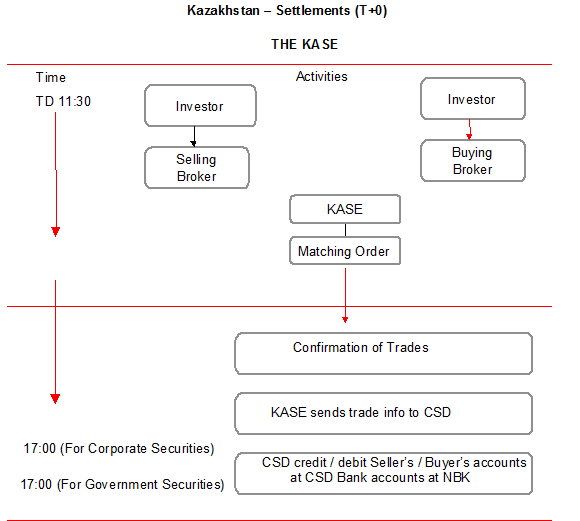
Government securities (treasury bills and short-term National Bank notes) as well as corporate shares listed on the Kazakhstan Stock Exchange (KASE) and traded through permanent auction, are settled real-time on trade date (T). 

* KASE introduced the T+2 settlement cycle for KASE index securities. T+2 with CCP has become the predominant trading mode on the KASE, where local and foreign equities, government and corporate bonds, investment funds and depositary receipts are now available for trading. Trades can be settled in both KZT and USD.


Delivery versus Payment (DvP) Settlement Currencies

Kazakhstan Stock Exchange (KASE):

Local Securities, Government & Corporate Bonds - KZT

Foreign Securities, inc. Depository Receipts - USD

Soverign Kazakhstani Euronotes & Foreign Eurobonds - KZT or USD

Astana International Exchange (AIX):

Securities denominated in a foreign currency - USD or EUR (Subject to AIX determination)

Local Securities - KZT


Over-the-Counter (OTC)

In Kazakhstan, only government securities and unlisted securities can be traded off-exchange, with foreign investors free to participate. The OTC market is not organised and is very small. Clients and counterparties can negotiate up to T+3 for OTC settlement, it depends on the agreement between the counterparties. There are no available statistics on the usual timeframe for the OTC trade cycle. 

Trading hours: Monday to Friday: 11:30 – 17:00

Settlement Procedures

Book-Entry: In Kazakhstan, the standard settlement cycle for listed equities, bonds and money market instruments is T+0. However, for over the counter (OTC) settlements, counterparties can also negotiate up to T+3. 

Government securities (i.e. treasury bills, short-term National Bank notes), listed shares and corporate bonds traded through continuous auction are settled in real-time on trade date (T). Unlisted equities and corporate bonds can be settled via the CSD any time between T and T+3.

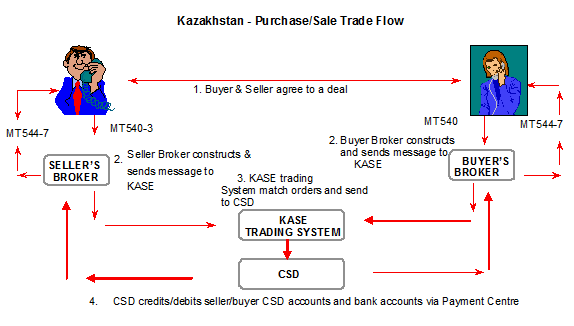
Custodians participate in the confirmation system of KASE. All trades executed on KASE to settle through the custodian's accounts with the CSD are subject to the custodian's confirmation prior to settlement. Custodians check trade details via electronic linkage to the trading system of KASE and confirm the trades. After this, trades are available to the CSD for settlement. Settlement takes place on trade-by-trade basis. 

Continuous auction is settled by the CSD automatically. CSD debits the buyer's bank account and credits the seller's bank account with NBK and simultaneously debits the seller's securities account and credits the buyer's securities account at the CSD. 

Exchange of securities and cash is continuous, irrevocable and almost simultaneous, but through separate systems.

Free of payment trades and Unlisted securities: Nominees may settle OTC trades with unlisted securities only via CSD. For free of payment trades that can be settled via CSD, CSD looks for two sets of matching instructions given by counterparties for the same SD. 

Please refer to the following flow charts for an overview of the settlement process in the Kazakhstan market.


Physical: Not applicable as the market is fully scripless.

Short Selling

Short selling is not allowed in Kazakhstan.

Turn-around Trades

Turn-around trades are possible provided that RVP takes place before DVP.

Clearing Agents

Central Securities Depository: As the CSD is electronically linked to the KASE and National Bank of Kazakhstan (NBK) payment centre, it provides DVP settlement for all on-exchange trades. 

The CSD automatically debits/credits counterparties' securities accounts and their bank accounts at the NBK via Kazakhstan Centre for Interbank Settlements (KCIS). The Real time communication between the CSD, KCIS and KASE was established in 1997.

Depositories

The Central Securities Depository (CSD) is the only depository in Kazakhstan. It was registered on July 18, 1997 as a closed joint stock company and is owned by 23 shareholders.

The CSD is regulated by the NBK, and it provides reports to the regulator on monthly basis. The CSD's authorised and paid-up capital is currently KZT 54,200,000.00 as of April 2013. CSD is a non-profit, non-commercial organisation. It provides depository, clearing and computerised book-entry settlement services. Participants in the CSD include Custodian banks and broker-dealers holding custodial and/or a broker- dealer license, international financial organisations and foreign depositories.

Bank for International Settlements (BIS) Settlement Model

BIS is an international organisation which fosters cooperation among central banks and other agencies in pursuit of monetary and financial stability. The Committee on Payments and Market Infrastructures (CPMI)uses three common structural approaches, or models, to categorise the links between delivery and payment in a securities settlement system.

Not applicable in the Kazakhstan market as DVP trades are executed by the CSD.

Registration Process

Book-Entry: all securities in the market are dematerialised and must be registered. As the market is fully scripless, registration is simultaneous with settlement. In accordance with NBK regulations issued in August 2003, custodians are required to hold all of their clients' assets at the Central Securities Depository (CSD). The CSD effects registration at the time of settlement for all on-exchange, over-the-counter (OTC) and delivery free/receive free transactions. For KASE trades, the CSD provides registration based on the trade details provided by KASE. OTC trades are registered based on the two sets of matching instructions received from counterparties.

Physical: not applicable as the market is fully scripless

Registrar

Registration of non-CSD securities: where registrar is involved, registration must be completed within three days of receiving transfer requests from the buyer as well as the seller. The seller's instruction must be provided either by the shareholder. The registrar issues extracts to both deliverer and receiver of the shares. Though the registrar is expected to effect settlement within three days of receiving matching instructions, they normally do so with a same day value.

Registration Period

At CSD: Registration takes place simultaneously with settlement. 
At Registrar: Registration must be completed within three days.

Penalties (fines) for failed trades in KASE
Bidder, who has concluded a deal and has not performed its obligations under the transaction is obliged to pay 5% penalty (from gross amount of trade) in favor of its counterparty.

Bidder, who has concluded a deal and has not performed its obligations under the transaction as a result of lack of cash position at KISC (Kazakhstan Interbank Settlement Centre of the National Bank of Kazakhstan), is obliged to pay a penalty (fine) in the amount of:

  1. 5% of the unexecuted transaction in favor of the party, whose obligations have been fulfilled, if the party refused to repeat the trade settlement for the unexecuted transaction
  2. 50 MCI1 in favor of the Stock Exchange in the event of a re-settlement of the unexecuted transaction
  3. 0% of the amount of the unexecuted transaction in favor of the party whose obligations are not fulfilled, if the repeat trade settlement has not been executed.

The current 1 MCI for year 2013 is KZT 1731.
Link: http://www.kase.kz/files/normative_base/reglament_t+0_eng.pdf

Risk

Disclosure Requirements

Share holdings may be required to be disclosed by the beneficial owner, particularly when holdings reach or exceed prescribed disclosure limits. Investors must ensure that they comply in full by reporting such holdings to the appropriate organisations for this market, within the timeframe required. If you have any questions regarding this issue we encourage you to consult your legal counsel. 

Failure to comply with reporting requirements may lead to penalties and/or other sanctions.

Foreign investors are subject to the following reporting requirements, which were last changed in May 2003, when the new "Law on Joint Stock Companies" came into force: 

A person independently or jointly with affiliated persons, who intends to acquire 30% or more of the voting shares of a company is obligated to notify the company and the NBK of such intention.

A person who independently or jointly with affiliated persons has acquired 30% or more of the voting shares of a company must within 30 days publish in the press an offer to the remaining shareholders to buy their shares at the determined market price in accordance with the legislation. 

The offer to shareholders about acquiring their shares must contain information about the person, and any affiliated persons, who have acquired the 30% or more of the voting shares of the company, including the names (trade names), place of residence (domicile), the number of shares owned by them and the offered sale price for the shares. 

Currently, there are no penalties for non-compliance of disclosure requirement and the investor may only be directed to unwind their positions if any ownership limits are breached.

Buy-Ins

There is no buy-in procedure on the KASE.

Securities Lending

Securities Lending and Borrowing is currently not permitted under local regulations in Kazakhstan.

Compensation Fund

There is currently no guarantee fund in Kazakhstan.

Anti-Money Laundering

The Law of the Republic of Kazakhstan "On Counteracting Legalization (Laundering) of Proceeds Obtained by Illicit Way and Financing of Terrorism" # 191-IV dated August 28, 2009, has been approved in Kazakhstan.

This Law stipulates legal framework and principles for counteracting legalisation (laundering) of proceeds obtained by illicit ways and financing of terrorism; the rights and obligations of financing monitoring entities, the authorised body and other governmental bodies of the Republic of Kazakhstan in the field of counteracting legalisation (laundering) proceeds obtained by illicit way and financing of terrorism.

The Law came into force six months from the date of first official publication (on March 9, 2010).

Foreign Ownership

Market Entrance Requirements

This is an FII market. Please contact your RBC Investor Services' Client Manager before making portfolio investments.

Regulatory approval is not required for foreign portfolio investment as well as foreign direct investment in Kazakhstan, however investors must register for tax purposes with the Tax Authority.

Investment Restrictions

Regulatory approval is not required for foreign portfolio investment as well as foreign direct investment in Kazakhstan, however there are foreign ownership restrictions in Kazakhstan.

Non-resident participation in the treasury bill market is regulated by the National Bank of Kazakhstan (NBK). From time to time, the NBK sets limits for non-resident participation. Such investments are subject to currency control regulation of the Republic of Kazakhstan. According to this regulation the foreign portfolio and foreign direct investments must be registered with the NBK if the amount exceeds USD300,000 or equivalent and the term is over 180 days. This includes the primary placement of securities made by local companies in the international capital markets as well as issuance of depository receipts against the securities of local companies. 

Kazakh law restricts foreign ownership in the sectors of financial services and telecommunications. The Banks and Banking Act 1995 prevents foreign investors and their related persons, who are registered in certain offshore zones, from holding shares of Kazakh banks. Other foreign investors are limited to holding not more than 10% of shares issued by any private bank, except with special permission from the NBK. The number of shares available to foreign investors for sale under privatisation schemes is also restricted. 

Section 22-2(4) of the National Security Act 1998 prohibits foreign investors, directly or indirectly in aggregate, from owning more than 49% of voting shares in telecommunications companies which operate long-distance landline facilities. 

Furthermore the following restrictions apply:

  • Any foreign investor may not own 10% or more of the shares issued by any open pension fund without special permission of the National Bank of Kazakhstan. This special permission may be granted only to those foreign investors which have a minimum rating of certain rating agency as required by NBK.
  • Total share capital of open pension funds with non-resident holdings can not exceed 25% of the total share capital of all such funds of the Republic of Kazakhstan.
  • Total share capital of pension asset management companies with non-resident holdings can not exceed 50% of the total share capital of all such companies of the Republic of Kazakhstan.
  • The Law on National Security also prohibits foreign investors to own directly or indirectly more than 20% of shares in any mass media company.
  • Governmental notes may restrict foreign investment in industries such as space, military or those under privatisation schemes.
Repatriation Policy

There are minimal controls on foreign exchange (FX) in Kazakhstan for foreign portfolio investors. These controls relate to the documentation (related to securities trades or income distribution) which is presented prior to the repatriation of sale proceeds or income from Kazakhstan. 

Funds, including income and capital gains can be freely repatriated subject to tax clearance. Investments in joint stock companies listed on the Kazakhstan Stock Exchange (KASE) are not subject to tax (other than withholding tax on dividends and interest) and sale proceeds can be freely remitted.

Cash

FX Regulations

Kazakhstan Tenge (KZT) is convertible for foreign investors who are allowed to maintain local as well as foreign currency accounts. There are almost no foreign exchange controls in Kazakhstan for foreign portfolio investors. Funds, including income and capital gains can be freely repatriated subject to tax clearance. 

The government exercises control over the exchange operations through its supervisory body the National Bank of Kazakhstan (NBK). For this purpose the NBK issues licences for exchange operations to second-tier banks and organisations authorised to conduct certain banking activities. The NBK regularly monitors and controls the activities of licensed banks. Local banks act as agents of the NBK for exchange and currency control related to local and foreign currency payments.

Same-day and spot trades can be executed through local commercial banks. Forward contracts are relatively uncommon. The majority of FX contracts are executed on the inter-bank market, and a smaller proportion on the KASE. The FX contracts executed on the KASE are based on KASE's average daily exchange rates.

Payment Systems

Payments in KZT are normally made via the Kazakhstan Centre for Interbank Settlements (KCIS) managed by the National Bank of Kazakhstan (NBK). All banks in Kazakhstan have correspondent accounts opened at KCIS (NBK). KISC runs two different systems, which are Interbank System of Money Transfer (ISMT) and Clearing system. Clearing system is a batch based system for processing of all payments that are less than KZT5 million in value. ISMT is a real time processing system, which processes all payments that are higher than KZT5 million in value.

Overdraft Permitted

Overdraft facilities are permitted by the legislation.

Entitlements

Dividend Process

Dividends on common and preferred shares are paid to the owners of shares as registered on the record date. Dividends are usually paid in cash although stock dividends are also available.

There is no real fixed dividend announcement date at present and it is generally up to the company concerned. According to Kazakhstan legislation, the announcement date is the date when shareholders at the AGM or the board of directors make the decision to pay dividends.

Dividend Payment Frequency

Dividend payments are usually made once per year although more frequent (quarterly) payments are also possible. Dividends are normally paid within first half of the year.

Interest Payment Frequency

Annually or semi-annually

Interest Accrual Rate

30/360 day basis

Corporate Actions

Common Events:

Redemption, interest/dividends payment, AGM/EGM, distribution of new shares by using pre-emptive rights.

Rights Tradeable:

No

New Shares from Exercised Rights:

Pre-emptive rights for purchase of new shares can be provided to shareholders.


Additional Information

N/A

Protection of Rights

Dividends are paid based on the registered positions as at record date.

Proxy Voting

Foreign Investor Restrictions

There are no restrictions for foreign investors to vote in the annual general meetings (AGM) and extraordinary general meetings (EGM) of companies. 

However please note that partial voting is not allowed in the market.

Shares Blocked

No

Meeting Notices/Agendas

Provided in Kazakh or Russian. General meeting announcements must be made at least 30 calendar days before the meeting date. In case of absentee and mixed voting, it should be no later than 45 calendar days before the meeting date.

Meeting Outcome

Must be published in the official newspaper within 10 days after the meeting.

Company Reports
  • Annual Financial Report of the Company
  • Audit Report of the Company
Power of Attorney

Required to vote through an authorised representative.

Other

In accordance with the changes on Joint-Stock Company Law, voting shares have to be registered in the name of beneficial holder. From September 1, 2005 the lists of eligible shareholders under CSD only based on information of the record system and on existing information about a holder without making requests to the depositors. 

Please note that in accordance with the changes to the Law "the shares with a vote are the distributed common shares and also those preferred shares which have a vote in cases provided by the present Law. The shares bought by the JSC are not among shares with a vote as well as the shares in nominal keeping and owned by a holder who is not fixed in a record system of the central depository". Therefore if the account is opened in the nominee name, the securities on this account can not participate in Annual General Shareholders Meeting. In order to participate, the account should be opened in the name of beneficial holder of securities (segregated structure).

Taxation

Dividend Tax Rate

15% withholding tax. For countries that have signed a double taxation treaty, this varies.

No WHT applies to dividends paid on securities (both shares and corporate bonds) listed on the Kazakhstan Stock Exchange (KASE).

Interest Tax Rate

15% withholding tax. Government securities and agency bonds 0%. For countries that have signed a double taxation treaty, this varies.

No WHT applies to interest paid on securities (both shares and corporate bonds) listed on the Kazakhstan Stock Exchange (KASE).

Capital Gains Tax Rate

15% on profit on sale of shares issued by local companies. No CGT applies to shares issued by residents irrespective of the method of trading, place of trading, and listing except shares issued by user of mineral resources. 15% CGT will be applied to capital gains resulting from trading of corporate bonds if trade is executed on the KASE by method of direct trade or off-exchange.

For countries that have signed a double taxation treaty, this varies. There is no CGT on government securities and agency bonds.

A tax exemption on income payments and capital gain deriving from unlisted securities will be granted to non-resident investors if these unlisted securities meet the three following conditions simultaneously:

  • shares have been held for more than three years
  • 50% or more of the value of the issuer's share capital or 50% or more of the shares issued by the issuer paying the dividends constitutes the property of the non-subsoil user
  • the issuer paying the dividends was not a subsoil user during the period for which the dividends are paid OR in case of capital gain, the issuer or the legal entity selling participatory interest is not a subsoil user (*)


(*) "Subsoil users" are individuals or legal entities engaged in operations involving the use of mineral resources, including oil operations, on the territory of the Republic of Kazakhstan in accordance with legislative acts of the Republic of Kazakhstan.

Tax Treaties

Austria
Armenia
Azerbaijan
Belgium
Belarus
Bulgaria
Canada
China
Czech Republic
Estonia
France
Finland 
Georgia
Germany
Hungary
India
Iran
Italy
Japan

Korea
Kyrgyzstan
Latvia
Lithuania
Luxembourg 
Malaysia
Moldova
Mongolia
Netherlands
Norway
Pakistan
Poland
Romania
Russia
Singapore
Slovak Republic
Slovenia
Spain
Serbia
Sweden

Switzerland
Tajikistan
Turkey
Turkmenistan
Ukraine
United Kingdom
United Arab Emirates
Unites States of America
Uzbekistan


Stamp Duty

N/A

Other Taxes

N/A

Holiday Calendar

KAZAKHSTAN Holiday Calendar

Local Websites

  • Kazakhstan Stock Exchange (KASE)kase.kz/eng/
  • Central Securities Depository (CSD) kacd.kz
  • National Bank of the Republic of Kazakhstan nationalbank.kz
  • The Kazakhstan Centre for Interbank Settlements (KCIS) kisc.kz
  • The Integrated Securities Registrar (TISR) www.tisr.kz