Denmark

Updated as at December 19, 2023


Market Account Opening Requirements

RBC IS operates an omnibus account structure in this market.

For further information or support around accessing this market, please contact your RBC IS representative.

Client Notice

Please note not all financial instruments and exchanges listed below are available as an RBCIS product offering. Please consult our Terms & Conditions or reach out to your RBCIS representative for further details.

Market Statistics

Currency Danish Kroner (DKK)
Time Zone GMT + 1
Nasdaq Copenhagen

  Market Capitalisation

Total Market  - DKK 7,518 billion (USD 1,201 billion)

  Number of Listed Issues

Equities - 127

  Average Daily Share Volume

29,092,329 shares of equity (per month)

  Average Daily Trade Value

DKK 5.9 billion (USD 942 million)

July 2021

Market Infrastructure

Exchange(s)

Nasdaq Copenhagen A/S
NASDAQ Copenhagen, known locally as the Kobenhavns Fondsbors A/S, is Denmark's only formal exchange, and dates back to the early 1800's. The Exchange's traditional open outcry trading practices were discontinued in 1989 when the exchange floor was closed and a new electronic trading system was installed.

In 2005, the CSE became part of the OMX-Group, which is listed on the exchanges in Copenhagen, Helsinki, Stockholm and Iceland. In February 2008, Nasdaq Copenhagen was established as the result of a combination of Nasdaq and OMX AB. Nasdaq Copenhagen A/S is still a company domiciled in Copenhagen and regulated by Danish laws and authorities.

Nasdaq Copenhagen Stock Exchange divides the Danish stock market into three sub-markets each covering one of the three main types of securities:

  • Shares
  • Bonds
  • Investment certificates

Approx 132 (as at November 2018) main market listed companies and more than 2,300 bonds, primarily government and mortgage credit bonds, are listed on the exchange. The bond market ranks among the seven largest in Europe in terms of market value. On the market for investment certificates more than 150 are listed. The derivatives market, also called the FUTOP market, is developing positively, but it is small in size by international standards.

Trading System

Trading in the following instruments is via Nasdaq Copenhagen's INET trading system:

  • Shares and Equity rights
  • Warrants and Certificates
  • Fund units and ETF's (Exchange Traded Funds)
  • Collective Investment undertakings
  • Fixed Income Securities

Derivatives are traded on the Genium Inet trading system.
The INET trading system electronically executes trades on either a matching or acceptance basis. Matching trades involve the system linking bids and offers, while acceptance trades are completed when a broker reviews outstanding bids and offers and selects one for execution. Bonds are traded on an acceptance basis only. Off-market (by telephone) trades are fairly common, although such trades must be reported to Nasdaq Copenhagen within five minutes of execution. 

INET was introduced on February 8, 2010 on the NASDAQ exchanges in Copenhagen, Helsinki, Iceland, Riga, Stockholm, Tallinn and Vilnius, and on June 20, 2011 for Fixed Income Securities. One of the most significant operational changes since the introduction of INET is the change in the format of the trade references. The trade ID from INET contains 9 or 10 characters.

Trading Hours

Monday to Friday:

Equities:

08:00 - 08:45

Pre-trading session

08:45 - 09:00

Morning call

09:00 - 17:00

Trading session

17:00 - 17:20

Post-trading session

Bonds:

08:30 - 17:00

Trading session


Interest sub-market (Bulletin board)
08:00-17:30

Issue sub-market
10:00-16:30

Over-the-Counter
There is limited trading activity in a small over-the-counter market for unlisted securities.

Security Identifiers

ISIN (International Securities Identification Numbering): Used

Other: N/A

Regulatory Bodies

The Danish Financial Supervisory Authority (Finanstilsynet) (DFSA) is responsible for the licensing and day-to-day supervision of all entities that play a role in the Danish securities market. As such, the DFSA licenses and supervises, amongst others, banks, stockbrokers, mortgage institutions, insurance companies, investment companies, pension funds, the Nasdaq Copenhagen Stock Exchange and the central securities depository. Its supervisory tasks include the monitoring of the solvency of the banks and the activities of all the above mentioned entities. The DFSA falls under the responsibility of the Ministry of Industry, Business and Financial Affairs. In addition to its supervisory tasks, the DFSA is, in cooperation with the Ministry of Industry, Business and Financial Affairs, also responsible for creating laws regulating the Danish financial sector. In this capacity the DFSA actively participates in the formation of EU legislation.

The Danish Business Authority, is an agency under the responsibility of the Danish Ministry of Industry, Business and Financial Affairs. The Danish Business Authority is the official place of registration for Danish businesses. Danish Business Authority administers legislation regulating businesses, amongst others the Companies Act and the Company Accounts Act. Registration and publication of business information favour the free market and provide businesses with good basic conditions.

Nasdaq Copenhagen's Market Surveillance is responsible for the monitoring of all trading activities on the exchange. This is mainly achieved by means of a credible, professional and integrated surveillance of the trading and the listed companies and also by assuming surveillance responsibility for the listing of equities and other financial instruments. Market Surveillance ensures that market principles, best execution rules and insider rules, etc. are being fairly observed. Cases may be referred to the DFSA, in accordance with the rules laid down in the Danish Securities Trading Act. The DFSA may subsequently report any suspected violation to the police.

FinanceDenmark safeguards the common interests of its members (banks, savings banks and Danish Mortgage Banks ) vis-à-vis the Danish Government, Parliament and public authorities. It is a professional organisation and its primary task is to create and maintain good operating conditions for the banks.

The Danish Securities Act as well as other financial legislation is in place to limit risks.

Instruments

Equities:

Shares, preference shares, B-shares, unit trusts, subscription and bonus rights, warrants

Debt:

Bonds, government bonds, mortgage bonds, index-linked bonds, floating rate bonds, CMOs

Money Market:

Treasury notes, treasury bills, Repos

Physical:

As 99.9% of all securities are dematerialised in the Danish market, physical securities do not really exist. However, physical securities can be kept in RBC Investor Services' sub custodian's vault

Other:

The FUTOP Clearing Centre in Copenhagen has been merged with the corresponding list in Nasdaq Stockholm. The FUTOP list in Copenhagen ceased to exist in December 2005.


Form of Securities

Nearly all listed securities are in book-entry form and generally denominated in DKK. The listed securities cover shares, bonds, money markets instruments, futures, options and mutual funds.

Board Lots

Equities:

Continuous trading can take place in round lots as well as odd lots. The value of a round lot for shares is approximately DKK 20,000 for OMXC20 shares and DKK 10,000 for other shares and investment certificates. Shares are traded in units that equal the above amounts, however, these are rounded up to 1, 5, 10, 20, 25, 50 or 100 shares.

Debt:

The number of government bonds included in a round lot represents a value of nom. DKK 1,000 and the number of mortgage bonds and other bonds included in a round lot represents a value of nom. DKK 1,000,000 for benchmark bonds and DKK 100,000 for other bonds.


Price Variations

In on-exchange trading, the order is to be placed in the trading system and in the market. Equity transactions are executed when the prices of the orders to buy and the orders to sell match or overlap. Best price has priority and orders entered in the order book have priority over orders entered later. A transaction is always executed at the price of the existing order. Danish shares are traded in both round lots and in odd lots, and both are freely tradeable.

Settlement & Registration

Settlement Cycles

Equities:

T+2

Debt:

T+2

OTC:

Upon agreement.

Money Market:

T+2 generally (T+0 and T+1 are available alternatives)


Delivery versus Payment (DvP) Settlement Currencies

DKK & EUR

Over-the-Counter (OTC)

There is limited trading activity in a small over-the-counter market for unlisted securities.

Trading hours: Monday to Friday as per regular settlement hours.

Settlement Procedures

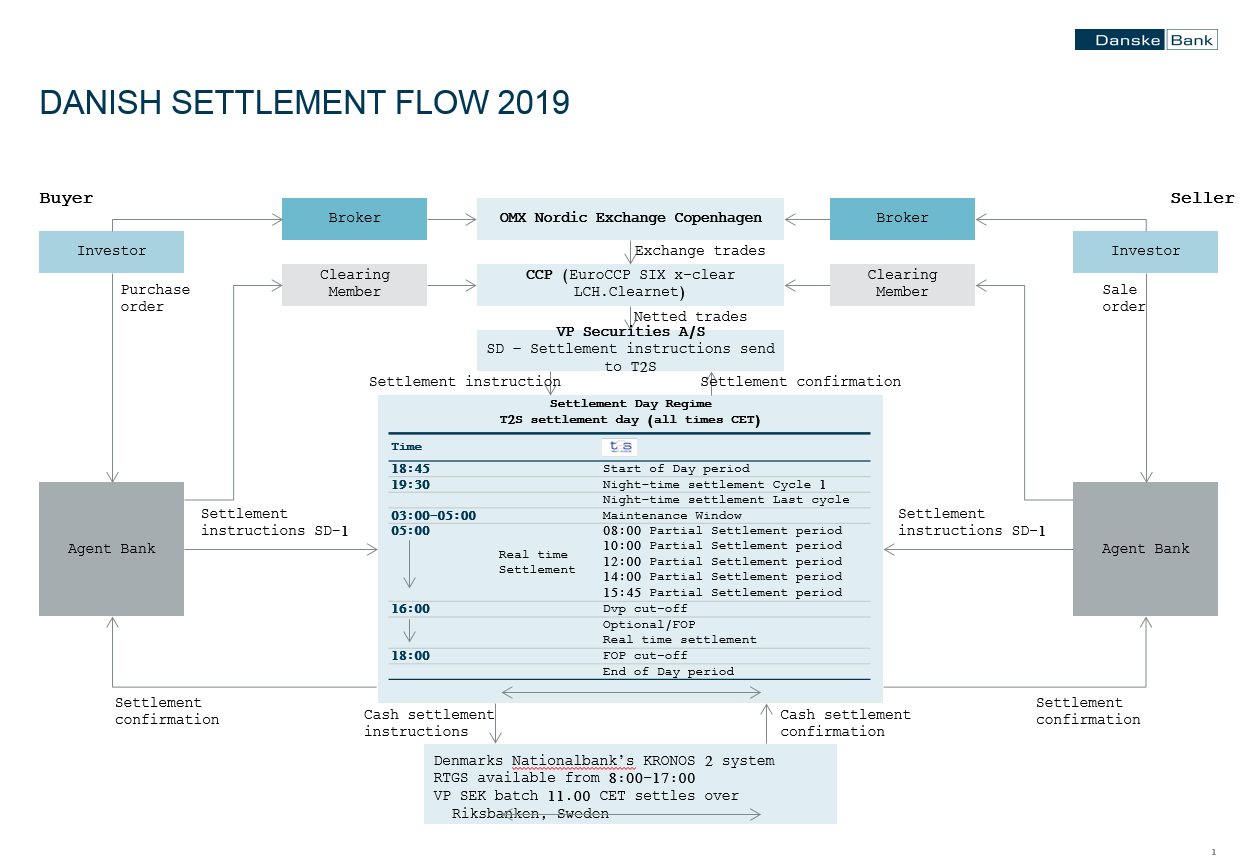
On-exchange trades are generated automatically from the Nasdaq Copenhagen's trading system via the depository to the sub-custodian's settlement system. No settlement instruction is required. On-exchange trades settle in the same system as off-exchange trades.

The local sub-custodian has a fully automated settlement system, which is directly linked to the local CSD, Euronext Securities Copenhagen. When the settlement instruction hits STP requirements, the instruction is forwarded electronically to the CSD with no manual interference. 

The market employs true delivery versus payment. Free of payment transaction are permitted and T+2 settlement cycle is standard in Denmark, but other settlement cycles are possible. Turnaround trades are permitted and securities lending is allowed to expedite securities settlement. Foreign investors do not need to fund their accounts prior to Settlement Date, but settlement can only take place if there are sufficient funds on the sub-custodian’s account with the central bank.

The settlement period in Denmark is T+2. Delivery takes place versus payment, the transfer of securities and funds occurring simultaneously. FOP settlement is also possible.  


Short Selling

Effective November 1, 2012, the relevant authority must be notified by investors of the short position of shares and government debt when the position reaches or falls below the levels specified in the regulation. The relevant authorities are the local Financial Supervisory Authorities (FSAs). 

The short positions of shares must also be disclosed to the public by posting information on the local FSA's website when a position reaches or falls below the specified levels. 

For full information of the new regulation and reporting requirements please visit the European Securities and Markets Authority website at http://www.esma.europa.eu/.

Turn-around Trades

As settlement is continuous throughout the settlement day in T2S, same day turnaround trades are possible. Trades can also be linked in T2S, meaning that settlement of a trade is dependent on another trade settling first.

Clearing Agents

EuroCCP NV (EuroCCP) offers interoperable clearing services for cash equity trades executed on Nasdaq Nordic, and its First North platforms.

LCH.Clearnet Ltd offers interoperable clearing services for cash equity trades executed on Nasdaq Nordic, and its First North platforms.

SIX x-clear Ltd offers interoperable clearing services for cash equity trades executed on Nasdaq Nordic, and its First North platforms.

Depositories

Clearing agent and depository are the same legal entity in Denmark.

Euronext Securities Copenhagen, the Danish CSD, previously called VP Securities is the only depository in Denmark.

Bank for International Settlements (BIS) Settlement Model

BIS is an international organisation which fosters cooperation among central banks and other agencies in pursuit of monetary and financial stability. The Committee on Payments and Market Infrastructures (CPMI) uses three common structural approaches, or models, to categorise the links between delivery and payment in a securities settlement system.

VP's settlement and clearing system follows DVP Model 1 - a system in which there is a simultaneous transfer of securities and associated funds from the buyer to the seller. All transfers occur on a trade-by-trade (gross) basis with all transfers made via book entry. All transfers are final, enables net settlement in both DKK and EUR, six settlement blocks, RTGS in DKK, automatic collateralisation as well as settlement via links with foreign clearing centres.

Registration Process

Book-Entry: 
Securities positions are transferred automatically between subcustodian accounts at VP. The name of a foreign investor can be linked to a specific account upon request.

Most Danish equities are issued as bearer instruments. However, the Articles of Association of some Danish companies foresee that shares can be registered in the register of shareholders maintained by the issuing company or its agent (e.g. a bank). It is to be noted that this registration is neither enforced by Danish law, nor by VP Securities A/S. Nevertheless, all Danish companies maintain a register of shareholders, and often registration is a prerequisite to exercise voting powers at a general meeting. The initiative to register lies with the investor.

The registration of the shares is instructed on-line by local custodians to the Danish CSD. The CSD then advises the company (or its agent bank) of the registration.

On December 15, 2014, VP Securities implemented a new public register of shareholders to comply with the Danish Companies Act of 2009 which requires shareholdings of 5% or more to be recorded under a publicly accessible register. Registration is conducted in the register by issuing companies when they receive notification of significant shareholdings. The register has been open for public access from June 15, 2015.

Danish debt instruments are also bearer.

Physical Securities: 
The selling custodian has the obligation to prepare the physical securities for re-registration ahead of delivery to buying custodian. The securities are sent by courier. Upon receipt of the physical securities the buying custodian will send the securities, by courier, to the Registrar for registration. Following the re-registration at the Registrar the securities will be returned by courier to the buying custodian and registered in the custody account of the buying counterparty. The securities are held in the subcustodian's vault. Such procedures are rare as over 99% of the securities in the Danish market are electronic.

Registrar

There is no central registrar and issuers very often appoint agents as registrars.

Registration Period

Registration of dematerialised securities takes place automatically upon settlement. Automatic registration is an integrated part of the processing of a securities transfer and it is initiated by VP. Physical share certificates are initially issued as registered but they assume bearer identity after the first delivery. The re-registration of physical shares is done by the company itself upon request by the owner of the shares.

If physical shares are to be registered in beneficial owner name for establishing the right to attend shareholders' meeting and to vote, the client (i.e. the owner of the physical shares) gives an order to the subcustodian for re-registration at the issuing company. Subcustodian then sends the physical shares to the issuing company on behalf of the client. The registration has to be carried out before the registration deadline set out by the issuing company.

Registration period for physical securities/proxy – There are no specific rules on how registration on physical securities should be. The rules are depended on the company’s regulations.

Risk

Disclosure Requirements

Registration of dematerialised securities takes place automatically upon settlement. Automatic registration is an integrated part of the processing of a securities transfer and it is initiated by VP. Physical share certificates are initially issued as registered but they assume bearer identity after the first delivery. The re-registration of physical shares is done by the company itself upon request by the owner of the shares.

If physical shares are to be registered in beneficial owner name for establishing the right to attend shareholders' meeting and to vote, the client (i.e. the owner of the physical shares) gives an order to the subcustodian for re-registration at the issuing company. Subcustodian then sends the physical shares to the issuing company on behalf of the client. The registration has to be carried out before the registration deadline set out by the issuing company.

Buy-Ins

Nasdaq Copenhagen's Buy-in process: Only relevant for On Exchange and CCP trades

Please see detailed information athttp://www.nasdaqomx.com/digitalAssets/98/98357_buy-in-procedure-and-guideline-1_6--may-4--2015.pdf

If the seller has not delivered the securities by S+2 at 09.00 the buyer may send the first notification of a possible buy-in to the seller. This day is identified as N. 

The first possible execution date for the actual buy-in is N+5 (S+7) at 08:00 at the earliest and the buyer has to send an updated notification to the seller informing that the buy-in has started. After the start (N+5), a maximum of 15 banking days is allowed for making the buy-in. If the last transaction is made on i.e. N+5+10, the cash settlement calculation should be defined and an updated notification form must be sent without delay. 

The payment of the cash settlement should be made by the selling party 10 banking days after the calculation (N+5+X+10) at the latest. The increase in the price of the buy-in transaction compared to the price of the original trade is considered a direct cost. The original seller is obliged to pay the difference between the two prices, if the price of the subsequent instrument is higher than the original contract price. The buyer should use best effort to avoid unnecessary costs for the seller. The buyer must be able to present a specification of the costs upon request.

If buy-in procedure is successful, the buyer has to inform the seller without any delay of the calculation of the cash settlement. This must be done by sending an updated notification form to the seller, and a copy to the relevant Trading Surveillance.

Notifications and other written agreements should be sent via e-mail or fax. Nasdaq Copenhagen's requests an e-mail address in order to receive buy-in notifications (this e-mail address is suggested to be generic and not personal). The buyer can send one buy-in notification to the seller for one or more original trades. The seller should confirm the received information without any delay by replying to the buyer and the local exchange.

For CCP-cleared on-exchange trades, the CCPs (EuroCCP and LCH.Clearnet) handle any buy-ins in accordance with their rules. The buy-in procedure will take place on the fourth business date after settlement, with execution on Intended Settlement Date + 5, in order to achieve delivery of shares for settlement purposes.

In addition late settlement fees are applied with two cost elements for the failing delivery party; a fixed fee and a variable cost: The fixed fee for the failing party is €25 per day per failing settlement position. The variable cost of 100bp per annum charged on a daily basis for the value of the failing settlement position was discontinued on February 1, 2014.

Securities Lending

Securities lending is legally permitted in Denmark. It is practised and there are established rules for the implementation of such transactions and for the collateral required. There is no centralised stock lending facilities with the CSD or the Exchange - Lending is available via commercial bank programmes 

However, as the Danish securities lending market is quite new, the scale of volume in borrow/lending transactions is very limited.

Compensation Fund

The CSD and the Stock Exchange have insurance which covers loss due to negligence, fraud and default. 

Under Danish law, the bankruptcy estate of a bank will be obliged to return assets belonging to the bank's creditors and clients as far as these assets are individualised in the estate.

In the unlikely event of a bank's bankruptcy, cash accounts cannot be separated from the bankrupt's estate. RBC Investor Services will, on behalf of themselves or their clients be registered as an unsecured creditor of the sub-custodian's bankruptcy estate and have a right to dividends in the sub-custodian's bankruptcy estate, if any. The Danish Guarantee Fund for Depositors and Investors covers deposits up to EUR 100,000 per depositor after deduction of debt and other liabilities. However, deposits made by other financial institutions, including foreign financial institutions, in their own name, will not be covered by the fund, regardless of whether such financial institution holds the cash on behalf of a third party, rather than for its own.

Anti-Money Laundering

Denmark is one of the charter members of the Financial Action Task Force on Money Laundering (FATF) and, as a member of the European Union (when applicable), is subject to the EU regulations concerning anti money laundering and the prevention of terrorist financing.

Act No. 117 of February 27, 2006 on measures to prevent money laundering and financing of terrorism has implemented the EU regulations concerning anti money laundering and the prevention of terrorist financing into Danish legislation.

Foreign Ownership

Market Entrance Requirements

Denmark is an FII market for the purposes of proxy voting only. Please contact your RBC Investor Services' Client Manager. There are no market entry requirements specific to foreign investors.

Investment Restrictions

None

Repatriation Policy

Funds can be repatriated freely.

Cash

FX Regulations

No specific regulations.

Payment Systems

The Danish Central Bank, Denmark's National Bank, plays a key role in relation to settlement of payments between banks and most payments are effected via the banks' accounts with Denmark's National Bank. The Denmark National Bank participates in the European payment system.

In Denmark, payments are settled in different systems, depending on the type of payment. A general distinction is made between gross and net settlement systems. KRONOS 2 is Denmark National Bank's real-time gross settlement (RTGS) system, and typically gross settlement systems are used for transferring large amounts between banks. KRONOS 2 is operative between 07:00 and 16:45. In the net settlement systems (also called netting systems), payments between banks are compiled and the net amounts owed between banks are calculated. A net amount is then calculated for each bank involved and, at a set time, these amounts are settled via the involved banks' accounts with Denmark National bank.

There are five netting instruments:

Sum Clearing

Intraday Clearing

Straksclearing

VP Settlement Clearing I Kronos 2

VP Settlement Clearing I T2S

Settlement can only take place if there are sufficient funds on the bank's account with Denmark's National Bank.

Overdraft Permitted

No specific regulations. This is negotiated bilaterally between the parties.

Entitlements

Dividend Process

Dividends are declared at companies' Annual General Meeting (AGM). The Danish Companies Act was amended on July 1, 2004 making the payment of extraordinary dividends permissible. Some unit trust funds investing in bonds pay interim dividends. Alternatives to cash dividends, such as stock dividends or reinvestment plans, are rare.

Ex-date is one day after the AGM and record date is two days after the AGM. Dividends are paid based on the settled position in the accounts at VP Securities A/S on record date.

Dividends are paid on an actual dividend payment basis. All transactions made prior to and on the date of the AGM carry an entitlement to dividend. Dividend entitlements on trades failing over the record date are claimed from the counterparty in the trade. 

When submitting a claim for refund of dividend tax, the following must be submitted along with the claim: 

SUPPLEMENTARY DOCUMENTATION

  • Beneficial owner name and address. If the claim is being made on behalf of the beneficial owner, a Power of Attorney (PoA) needs to be included, issued by the actual beneficial owner. If the PoA is issued by a third party, supporting documentation needs to be included, to show the full chain of authorisation from the beneficial owner. 
  • Certification from the competent local authority, which certifies that the beneficial owner lived in a country covered by a double taxation agreement with Denmark at the time the dividend distribution took place, and is liable to pay tax in said country. This is either a Beneficial Owner Certificate of Residence or a Certificate of Tax Residence. 
  • Any Other relevant Documentation
Dividend Payment Frequency

Annually, on the third business day following the annual general meeting. However, payments of additional dividends are possible.

Interest Payment Frequency

Interest on most government bonds is paid annually, whereas interest on mortgage bonds is paid annually, semi-annually or quarterly.

Ex-date is one day prior to the record date and the record date is one day prior to the payment date. Partially redeemed quantities marked 'of which redeemed' has been removed under new redemption model.

Interest payments and redemptions are executed in the same way as for dividends.

Interest Accrual Rate

Actual/actual basis.

Interest accrues from the previous coupon date up to, but excluding the settlement date.

Corporate Actions

Common Events: Bonus and subscription rights, mergers, tenders and stock splits.

Rights Tradeable: Yes, for 10 business days. Trading in subscription rights commences two banking days prior to the first subscription day and ends two banking days before the last subscription day.

New Shares from Exercised Rights: Paid on last day of subscription period, provided instructions are received prior to that day. If instruction are received on last day of subscription: pay day = last day of subscription period + 1.

Additional Information

All corporate events are processed through VP Securities A/S, the Danish Central Depository. 

No official announcement date exists in the Danish market for rights and bonus issues. Generally rights and bonus issues are announced several weeks prior to the start of the issue period. Ex-date is the first business day of the issue period, and coincides with the first trading day at the CSE. 

VP Securities A/S makes the allotment of the rights on record date, which is one business days after ex-date. The allotment is based on settled position at 12:30 CET on record date. The subscription period for rights and bonus rights starts on the business day following record date. Rights and bonus rights are usually tradeable for 10 days, with the trading period ending two business days prior to the end of the subscription period. New shares are distributed on the last day of the subscription period. They are generally issued with different ISIN codes and will rank pari passu. 

Mergers and stock splits take place at a pre-announced date agreed upon between the company, VP Securities A/S and Nasdaq Copenhagen. Ex-date is one business day prior to the date of the event. Record date is the day on which the event takes place, following the daily update of the VP Securities A/S records. Tender Offers, usually, are valid for about 4 weeks. 

Drawings are performed according to a percentage base drawing procedure. This procedure applies to both government bonds and mortgage credit institutions bonds. Percentage rate announced to the market is a factor with ten decimals.

Protection of Rights

According to Danish law, to exercise voting rights, a shareholder must either attend a general meeting in person or exercise them by proxy.

Information regarding SRD2 - Issuers of shares who have their home office in an EU Member State, and whose securities are traded on the EU/EEA’s regulated markets, need to comply with the requirements outlined in the directive. SRDII establishes rights that enable Issuers to identify their shareholders, informs shareholders proactively and creates a framework for shareholders to have easier access to exercise of their shareholder rights. For example, by voting at general meetings.

SRDII gives issuers the right to identify all their shareholders. All intermediaries who hold the share in question, either on their own account or on account on behalf of someone else, are required to respond to the Issuer’s request. The Issuer has the right to appoint an intermediary to collect the shareholder information from other intermediaries in the chain.

Proxy Voting

Foreign Investor Restrictions

RBC Investor Services' sub-custodian offers proxy voting services for all clients who hold shares in segregated accounts and in nominee accounts.

Shareholders who have their registered holding distributed among several segregated accounts are nevertheless recorded as single beneficial owners in the register of shareholders maintained by the issuing company or its registrar. Therefore, split voting is not allowed even if the shares are held among several segregated accounts.

The Danish Companies Act stipulates that a shareholder must attend a meeting to be eligible to vote or, alternatively, exercise their right to vote by proxy.

Shares Blocked

No

Meeting Notices/Agendas

The date for an upcoming General Meeting (GM) must be published at least eight weeks prior to the date of the meeting. Shareholders have the right to request that items are added to the GM agenda. Official meeting notice including agenda must be announced between five to three weeks prior to the meeting.

Meeting Outcome

The minutes including the specifications of voting for each proposal must be published within two weeks of the meeting.

Company Reports

Provided on best effort basis. Reports are available in English from major companies, usually on the company website.

Power of Attorney

Noo longer required in Denmark. However if you want to vote for Greenland and Faroe Island it is required to provide a PoA.

Other

Record/registration date of seven calendar days before the meeting.

Market proxy deadline is three days before the meeting.

Taxation

Dividend Tax Rate

27% withholding tax. The reclaimable amount following from a Double Taxation Treaty must be reclaimed, as there is very limited relief at source in Denmark for clients other than those named below. 

Danish companies, which have segregated custody accounts registered in the beneficial owner's name at VP, are eligible for tax relief at source of 25%. These companies do not have to reclaim tax after dividend payments.

Due to the discovery of extensive fraud in the Danish reclaim process up to and in 2015, the Danish Tax Authorities introduced a new, electronic reclaim procedure, replacing both reclaims via physical forms and via the electronic block reclaims, where minimal information was required. There is now only one method to reclaim, starting 1st April 2017.

DANISH DIVIDEND TAX RECLAIM PROCEDURE FROM 1ST APRIL 2017

A reclaim spreadsheet detailing the basis for the reclaim must be forwarded to the local sub-custodian together with the relevant supplementary documents in pdf form.  

SUPPLEMENTARY DOCUMENTATION REQUIRED FROM RBC’S CLIENT

  • Beneficial owner name and address. If the claim is being made on behalf of the beneficial owner, a Power of Attorney (PoA) needs to be included, issued by the actual beneficial owner. If the PoA is issued by a third party, supporting documentation needs to be included, to show the full chain of authorisation from the beneficial owner. 
  • Certification from the competent local authority, which certifies that the beneficial owner lived in a country covered by a double taxation agreement with Denmark at the time the dividend distribution took place, and is liable to pay tax in said country. This is either a Beneficial Owner Certificate of Residence or a Certificate of Tax Residence. 
  • Any Other relevant Documentation

Templates for the below two documents are available on the Tax Authorities website at:  

http://www.skat.dk/SKAT.aspx?oId=2236538&vId=0&lang=US

Form
number

Form name

Mandatory
Yes /No

02.051

Place of residence statement
for companies etc.

Yes – or another document signed by foreign tax authorities

02.050

Place of residence statement
for private individuals

Yes – or another document signed by foreign tax authorities

Template for the below document is available on the Tax Authorities website at:

 http://www.skat.dk/skat.aspx?oId=119350

Form
number

Form name

Mandatory
Yes /No

Explanation

02.034

Residence and tax liability
For private individuals

Yes

Declaration that the beneficial owner is tax liable in their place of residence

The local sub-custodian will liaise with the Danish Tax Authorities, ensuring that all necessary information has been supplied. When the reclaim has been fully processed, the amount will be credited your cash account.

The Danish tax authorities announced that the Statute of Limitations for the reclaim of Danish dividend tax based on Double Taxation treaties was reduced from 5 to 3 years as of 13th September 2016

The Danish withholding tax on Danish dividends received by non-resident companies was reduced from 27% to 22% as of July 1, 2016.

The reduction to 22% also benefits companies from outside the EU/EAA area for dividends received after July 1, 2016.

As Danish legislation is considered to have been in conflict with EU legislation, companies resident in the EU/EEA states, which have paid higher tax rates than that applicable for Danish companies, may reclaim excess withheld tax as follows:

Year


Reclaim down to

2007 to 2013


25%

2014


24.50%

2015


23.50%

2016  (if dividend paid before 1 July, 27% was withheld)


22%

This amendment has no impact for individuals, the withholding tax remains at 27% for individuals.

As of March 1, 2023, a full tax exemption via domestic law will no longer be available to beneficial owners qualifying as foreign states (and their institutions). Beneficial owners that are residents of a Double Taxation Treaty (DTT) country may however reclaim withholding tax on dividends using the standard refund procedure.

Interest Tax Rate

Exempt

Capital Gains Tax Rate

Exempt

Tax Treaties

Argentina
Armenia
Australia
Austria
Bangladesh
Belarus
Belgium
Bosnia & Herzegovina
Brazil
Bulgaria
Canada 
Chile
China
Croatia
Cyprus
Czech Republic
Egypt
Estonia 
Faroe Islands 
Finland 
France
Georgia 
Germany 
Greece 
Greenland
Hungary

Iceland
India
Indonesia 
Ireland 
Israel 
Italy 
Jamaica 
Japan
Kenya
Korea (South)
Kuwait
Kyrgyzstan 
Latvia 
Lithuania 
Luxembourg
Macedonia
Malaysia 
Malta 
Mexico 
Montenegro
Morocco
Netherlands 
New Zealand
Norway 
Pakistan 
Philippines

Poland
Portugal
Romania 
Russia 
Serbia 
Singapore 
Slovak Republic
Slovenia 
South Africa
Sri Lanka 
Sweden
Switzerland 
Taiwan
Tanzania 
Thailand
Trinidad and Tobago
Tunisia
Turkey
Uganda
Ukraine 
United Kingdom 
United States
Venezuela
Vietnam 
Zambia

Treaties with France and Spain: following the termination of the double taxation treaties with France and Spain on January 1, 2009, the Danish tax authorities decided to allow tax reclaims from both Spanish and French investors. 

Stamp Duty

No stamp duty is paid in the Danish market.

Other Taxes

None

Holiday Calendar

Denmark Holiday Calendar

Local Websites