Mauritius

Mis à jour le mai 30, 2022


Statistiques du marché

Currency Mauritian Rupee (MUR)
Time Zone GMT + 4
The Stock Exchange of Mauritius (SEM)

  Market Capitalisation

USD 9.01 billion (MUR 309.85 billion) (June 2019)

  Number of Listed Issues

100 (96 domestic, 4 foreign) (June 2019)

  Average Daily Share Volume

-

  Average Daily Trade Value

Equities: USD 38.51 million (MUR 1.30 billion)

Bonds: USD 2.28 million (MUR 77.27 million)

(Monthly average YTD June 2019)

Infrastructure de marché

Échange(s)

The Stock Exchange of Mauritius (SEM) 
SEM is the only stock exchange in Mauritius. It was incorporated on March 30, 1989 as a Private Limited Company. The SEM operates two exchanges: the Official Market, on which securities of listed companies are traded and the Development and Enterprise Market (DEM). The Official Market started its operations in 1989 with five listed companies and a market capitalisation of nearly USD 92 million.  The volumes have grown manifold and currently there are 51 companies listed on the Official Market representing a market capitalisation of nearly USD 7.7  billion as at December 08, 2017

The Development & Enterprise Market (DEM) is a market designed for companies quoted on the Over-The-Counter (OTC) market, Small and Medium-sized Enterprises (SMEs) and newly set-up companies which possess a good growth potential. Since March 2007 trading on the DEM is being conducted on a daily basis. Furthermore, the daily trading sessions of the DEM run in parallel with those on the Official Market. SEM is a majority shareholder in the Central Depository and Settlement Co. Ltd (CDS) which acts as a depository as well as the clearing house for the securities settlement.

Trades can be settled in USD for trades in securities denominated in foreign currency other than USD, EUR, GBP and ZAR.  Trades denominated in the four stated currencies can be traded in the primary currency and the local MUR currency.

Venture Market
SEM has set up a new market, the Venture Market, which allows shareholders of unlisted companies to trade their securities on a transparent and organized market platform. The Venture Market aims to facilitate secondary trading of securities issued by start-ups and SME’s, enhance trading liquidity in their underlying securities and facilitate capital-raising by those entities. It also aims at acting as a feeder market for SEM's regulated listed markets namely, the DEM. 

Système de commerce

The new Automated Trading System of the Stock Exchange of Mauritius went live on May 13, 2022. The new ATS incorporates modern high-end surveillance modules, which will enhance real-time surveillance of market activities. It will also facilitate foreign investors' access to the market through FIX connectivity to order-routing networks and Order Management Systems.

Heures de commerce

Monday to Friday:

Pre-opening:

09:00 - 10:00

Opening:

10:00

Continuous Trading:

10:00 - 14:40

Closing

14:30

Identificateurs de sécurité

ISIN (International Securities Identification Numbering): Yes
The Central Depository and Settlement Co. Ltd. (CDS) has been a member of the Association of National Numbering Agencies (ANNA) since March 2000 and is responsible for allocating ISIN numbers to financial instruments in Mauritius. ISIN codes of 12 alphanumeric characters, for stock identification, are used for both the Official and the DEM markets.

Other: None

Organismes de réglementation

Stock Exchange of Mauritius (SEM): was set-up in March 1989 under The Stock Exchange Act, 1988. SEM is the only stock exchange in Mauritius. The SEM has recently been admitted as a member of the World Federation of Exchanges (WFE). The SEM is a private company incorporated under the Companies Act 1984. Since October 06 2008, the SEM has become a public company and is a member of the World Federation of Exchanges (WFE). It provides facilities for buying and selling shares, maintains a clearing house and issues rules and regulations for the stock exchange. The SEM operates two exchanges: the official market and the Development and Enterprise Market (DEM). The Board of Directors includes representatives from member Investment Dealers and the Chamber of Brokers Further details available athttp://www.stockexchangeofmauritius.com/board-of-directors. It is responsible for managing the operations of the stock exchange and provides facilities for buying and selling shares, maintains a clearing house, and issues rules and regulation regarding the conduct of trading operations. 

Financial Services Commission (FSC): is the integrated regulator for the financial services sector other than banking and global business. The FSC was established in 2001 and operates under the Financial Services Act, the Securities Act and the Insurance Act to licence, regulate, monitor and supervise the conduct of business activities in these sectors as well as non-financial institutions in Mauritius. The non-bank financial sector includes institutions involved in insurance and pensions, capital market operations, leasing and credit finance, as well as global business activities.

The team heading the commission comprises the chairman, vice-chairman, chief executive and five members.

The objectives of the commission are:

  1. To regulate the industry by establishing rules to adapt the regulatory structure to new circumstances
  2. To issue guidelines in line with international standards of regulation, promoting good governance and establish codes of best practice
  3. To monitor all off-site statutory filings submitted by licensed companies to ascertain that they comply with licensing and ongoing obligations particularly that of financial soundness. Financial statements and annual reports are examined for disclosures made by companies and ensure compliance
  4. To review rules and propose new mechanisms to check for market malpractices. This includes monitoring stock markets for market manipulation, insider trading, money laundering practices and products mis-selling by market intermediaries.
  5. To ensure competence, integrity, and financial soundness of applicants for new licence


Bank of Mauritius (BOM): the central bank, operates under the authority of the Bank of Mauritius Act. Its operations were established in September 1967. With the enactment of the Loans Act of 1974, the BOM has been vested with the responsibility of issuing government securities. It also acts as a clearing house for the clearance of cheques and administers the daily settlement of cash considerations raised by the other Mauritius depository, Central Depository and Settlement Co Ltd (CDS), resulting from trading on the Stock Exchange of Mauritius.

The main functions of the central Bank include:-

  1. Formulation and implementation of monetary policy
  2. Issuer of currency
  • Banker to the Government and to banks
  1. Provider of an efficient payment, settlement and clearing system
  2. Management of the public debt
  3. Management of foreign exchange reserves
  • Regulator and supervisor of banks
  • Adviser to the Government on financial matters.


The basic objectives of the Banking Act are to maintain a sound banking system in Mauritius and to protect the interests of depositors. It incorporates the following principles of prudential regulation and supervision of banks:-

  1. Licensing of Banks
  2. Capital Adequacy
  • Quality of Management
  1. Liquidity Control
  2. Concentration of Risk
  3. Role of External Auditors
  • On-site Examinations
  • Off-site Surveillance
  1. Control of Advertisements
  2. Confidentiality of Information
  3. Identity of Customers


Sustainability Index

Stock Exchange of Mauritius launched the Sustainability Index (SEMSI) on 7 September 2015, which tracks the price-performance of those companies listed on the Official Market or the Development & Enterprise Market (DEM) which demonstrates strong sustainability practices. The SEMSI has an integrated approach and takes into consideration all four key pillars of sustainability (economic, environmental, social and corporate governance).

Forme des titres

All listed securities are dematerialised into the CDS.

Lots de la commission

Equities:

The Official Market and the Development Enterprise Market comprise of Equity Board, Odd Lot Board and Special Terms Board.


The Equity Board is meant for trading of listed ordinary shares and preference shares. Trading unit will be in multiples of 100 securities subject to a minimum of 100 securities.

The Odd Lot Board is designed for trading of listed ordinary shares and preference shares whose buy and sell orders have quantities less than 100 securities. Trading unit will be one security subject to a maximum of 99 securities. Odd lots trading cycle consist of continuous session only.

The Special Terms Board is designed for undertaking specific types of trades as and when the need arises based on market requirements. It in turn consists of the All or None Board, Crossing Board and Buy-In Board

Debt:

The Debt Market comprises of Debt Board and Crossings Board. The Debt Board is for the trading of corporate debentures & bonds and government securities.

Variations de prix

Prices can vary during one trading session by a fixed maximum limit of +/- 20% for the Official Market and 20% for the OTC DEM Market. In the event a price limit is reached, a quotation is established at the limit price after investment dealers hand in the volume of their orders in writing and the available supply or demand of shares is satisfied on a pro-rata basis.

Règlement et enregistrement

Cycles de règlement

Equities (book-entry):

T+3

Debt (book-entry):

T+3 - Corporate Bonds

Money Market:

T+1 - Treasury Bills

Hors cote (OTC)

The Over-the-Counter Market closed from January 30, 2007.

Procédures de règlement
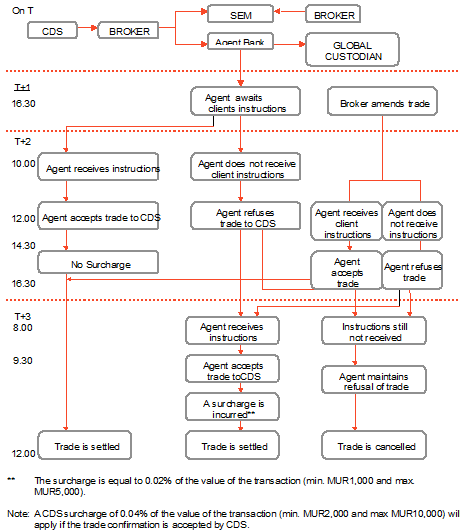
  • On trade date (T), the Central Depository and Settlement Co Ltd (CDS) makes available to local custodian banks a settlement and a transaction report in respect of transactions effected on behalf of their clients by investment dealers during T. The investment dealers also deliver the relevant trade contract notes to the local custodian banks.
  • Custodian banks are required to confirm those trades that have been refused to the CDS by 12:30 on T+2, for which settlement instructions have not been received. A trade which has been refused, may subsequently be confirmed by the custodian bank up until 09:00 on T+3, however this will be subject to a CDS surcharge of 0.02% of the value of transaction with a minimum of MUR 1,000 and a maximum of MUR 5,000. Further, the CDS may accept trade confirmation of a sale transaction between 09:00 on T+3 and 09:00 on T+5 to abort a buy-in against the transacting investment dealer. A CDS surcharge of 0.04% of the value of the transaction (a minimum of MUR 2,000 and a maximum of MUR 10,000) will apply if such confirmation of a trade (which was refused earlier) is accepted by the CDS.
  • The sale transaction will be settled through the CDS on the next business day following the day the sale transaction is confirmed with the CDS.
  • On T+3, the CDS submits to each securities settlement bank a revised settlement report in respect of trades effected on T.
  • On T+3, the custodian bank arranges to remit to the clearing bank (Bank of Mauritius) by 10.30, the net value of trades effected on T. The clearing bank will, on the same day at 12:00, arrange to credit the respective participants' accounts under advice to the CDS.
  • Once the central bank effects confirmation of funds settlement in writing to the CDS, the latter will action the securities settlement by debiting and crediting securities accounts of the two counterparties involved. All payments and movement of securities are final when made.

Mauritius - Securities Settlement Flowchart
under T+3 Settlement Cycle

Please note that the deadline to receive instructions for trades amended by the broker on T+1 is T+2 at 16:30, and the deadline to receive instructions on T+3 for trades refused on T+2 is 09:00. 

The market supports negative affirmation and as such trades are not required to be confirmed to the CDS when instructions are in place. Only when settlement instructions are missing or unmatched by T+2, are such trades refused.

Vente à découvert

Short selling is not allowed in the market.

Métiers alternatifs
Agents de compensation

The Central Depository and Settlement Co Ltd (CDS)
The Central Depository & Settlement Co. Ltd (CDS) was established by the Stock Exchange of Mauritius in 1996 to provide centralised depository, clearing and settlement services for the Mauritian equity and debt markets and became operational in January 1997. The setting up of CDS has brought about prompt and efficient clearing and settlement of trades while at the same time reducing some of the inherent risks in the process. 

The CDS complies with the international standards (Group of 30 Recommendations; Core Principles for Systemically Important Payment Systems / International Organisation of Securities Commission – CPMI/IOSCO Recommendations) on depository, clearing and settlement systems. The CDS qualifies as an Eligible Securities Depository under the US Investment Company Act Rule 17f-7. The CDS provides its services within an online computer system with participants having direct online access to the system. Trades are settled within a rolling T+3 settlement cycle on a strict Delivery versus Payment (DvP) basis. Final and irrevocable transfer of funds occurs through the central bank with same-day funds on settlement date.

Cash: The Bank of Mauritius (BOM)
The BOM acts as the Clearing Bank (as stipulated in the CDS Act).

Once the BOM confirms that funds settlement has occurred, the CDS transfers the shares between the securities accounts of the respective clients.

Dépositaires

Equities: The Central Depository and Settlement Co Ltd (CDS)

Debt: The Bank of Mauritius (BOM)

Please refer to the above for details.

Banque des règlements internationaux (BIS) modèle de règlement

BIS is an international organisation which fosters cooperation among central banks and other agencies in pursuit of monetary and financial stability. The Committee on Payments and Market Infrastructures (CPMI) uses three common structural approaches, or models, to categorise the links between delivery and payment in a securities settlement system.

In Mauritius all listed securities settle on a DvP basis under BIS Model 2 - Gross simultaneous settlement of securities followed by net settlement of funds, with finality at 12:00.

Securities are settled on a trade by trade basis and cash is settled on a net basis between depository participants who undertake to guarantee the availability of stock and funds. The CDS system checks the securities balance each time a trade is allocated to a client account. On settlement date, funds transfer between the seller's and buyer's participants takes place on a net basis through the participants' settlement banks and the clearing bank (Bank of Mauritius). Simultaneously the seller's (either the participant's account or the client's account) Securities Accounts is debited and the buyer's (either the participant's account or the client's account) Securities Accounts is credited.

Processus d'inscription

Book-Entry:

Registration of securities held at the depository is automatic on settlement.

Physical:

Not applicable. Settlement takes place in scripless form.

Chef du service des inscriptions

There is no central registrar. Registration occurs automatically via the CDS.

Période d'inscription

Not applicable as registration is automatic upon settlement.

Risque

Exigences de divulgation

There is no Disclosure Requirement on Shareholding under the Companies Act 2001. Details on shareholdings are however filed with the Registrar of Companies along with the annual return. The Listing Rules require disclosure of substantial shareholding (5% or more) in the annual report. The Constitution of a company also may impose restrictions on share holdings which a shareholder should abide but this varies from company to company.

Share holdings may be required to be disclosed by the beneficial owner, particularly when holdings reach or exceed prescribed disclosure limits. Investors must ensure that they comply in full by reporting such holdings to the appropriate organisations for this market, within the timeframe required. If you have any questions regarding this issue we encourage you to consult your legal counsel. 

Failure to comply with reporting requirements may lead to penalties and/or other sanctions.

Acheteurs

For failed CDS trades, buy-ins are initiated by the SEM and the CDS on settlement date.The CDS will designate an Investment dealer to effect the buy-in on its behalf by drawing of lots. The defaulting investment dealer will not be allowed to effect buy-in on behalf of the CDS. The CDS will inform SEM of the buy-in by 09.45 on the third business day following the business day on which the trade took place (T+3) and will provide SEM with the fail trade details. The CDS will inform the Participants involved in the failed trade and in all turn around trades linked to it, of the securities failure by 09.45 on the third business day following the business day on which the trade took place (T+3). The buyer participant involved in the last transaction in each chain of turnaround trades will be informed that it will have to pay for the securities purchased during the buy-in at the original price at which the said transaction was executed.

Prêt de titres

Permitted. Securities lending and borrowing is allowed. However, Securities Lending and Borrowing has been partially implemented only to cover for delivery failures.

Fonds d'indemnisation

The CDS has established a Guarantee Fund to guarantee the settlement of transactions in the event of a default by a Participant.

The Guarantee Fund is managed by the CDS. The SEM has not set up a separate Guarantee Fund. In accordance with Section 3(8a) of the Securities (Central Depository, Clearing and Settlement) Act 1996, the CDS has set up a Guarantee Fund for the purpose of providing an indemnity against any default in respect of payments for or delivery of securities and of obligations of Participants towards CDS. The CDS Guarantee Fund is used to guarantee the settlement of transactions in the event of a default by a Participant. In such a situation, the Guarantee Fund steps into the net settlement mechanism and makes good the obligation of the defaulting Participant. The Guarantee Fund will seize the unpaid securities and sell these back on the market in order to replenish itself. The Guarantee Fund acts as a shock absorber in the event of a settlement failure and thus prevents the market from collapsing through systemic effect. The Guarantee Fund contributes to create confidence in the stock market. It is important to note that to date there has never been any failed trade in the CDS. 

The Fund is constituted of cash contributions by investment dealers and CDS, as well as Letters of Credit provided by investment dealers. The CDS contributes part of its transaction fees to the Fund. The assets of the Fund are segregated from those of the CDS (separate bank accounts) and are available only for the purpose of the Fund as required by law. The Fund is independently managed by the Business Conduct Committee. The size of the Fund as at June 30, 2016 was as follows:

  • Cash contributions:Rs 32,772,573
  • Letters of Credit/Deposits submitted by investment dealers:Rs 32,790,000
  • The Fund can also have recourse to a standby line of credit of Rs 50M from its bank.
Lutte contre le blanchiment d'argent

Combat fraud and money laundering - The FSC takes measures to prevent and address investment business abuse, market abuse and financial fraud in relation to any activity conducted in the non-banking financial services and global business sector by implementing an Anti-Money Laundering and Combating the Financing of Terrorism (AML/CFT) framework and adhering to international norms and standards.

Propriété étrangère

Exigences d'entrée sur le marché

There is virtually no restriction on foreign investment in companies listed on the Stock Exchange. Foreign investors do not need approval to trade shares, unless investment is for the purpose of legal or management control of a Mauritian company or for the holding of more than 15% in a sugar company. Foreign investors benefit from numerous incentives: revenue on sale of shares can be freely repatriated, and dividends and capital gains are tax-free.

Restrictions d'investissement

Some listed companies may have clauses in their memorandum and articles of association to restrict individual or collective foreign ownership. Any investment should not result in the exercise of legal or management control of a Mauritian company. 

Sector limitations:
(i) Sugar companies – Less than 15%
(ii) Banks – Requires approval of Central Bank for more than 10% shareholding
(iii) State Bank specific requirement – Section 2.8.1 No shareholder shall hold directly or indirectly more than 3% of the issued share capital less any treasury shares of the Company without previous authorisation of the Board of Directors of the Company. No authorisation shall be given to that effect unless a Special Notice has been sent to the Directors specifying that such a question is included in the Agenda of a Meeting of the said Board. 

The above provisions shall not apply to those of the shareholders who were holding more than 3% of the issued share capital of the Company before the tenth day of March one thousand nine hundred and ninety five, provided always that each of those shareholders shall at no time hold a higher percentage of the issued share capital of the Company than the percentage each said shareholder was holding at above date. 

The provision of Article 2.8.1 shall not apply to International Financial Bodies, International Banks, International Institutions and such International Organisations as the Board of Directors of Company may expressly authorise to hold a higher percentage. 
(iv) Air Mauritius –   No Shareholder shall hold more than 2.5% of the Issued Share Capital of the company without previous authorisation of the Board of Directors of the Company.

Important note: 
1) Prior approval from the FSC to invest in 15% or more of the voting capital of a Mauritian Sugar company is required. 
2) FSC's approval also required if Foreign Investor invests in securities resulting in the exercise of legal or management control of a Mauritian company

Politique de rapatriement

Since July 1994 all foreign exchange controls have been lifted and funds can be remitted and repatriated freely. Foreign investors are able to repatriate all capital, profits and income freely subject to foreign currency reserves being available. The Mauritian rupee is a fully convertible currency. Free market forces determine the value of the Mauritian rupee. 

Forex transactions are executed by Banking Institutions who hold a dealing licence from the Bank of Mauritius (Central Bank). There is no official exchange rate published.

Cash

Régulations FX

The local Mauritian Rupee is a fully convertible currency and is not subject to any foreign exchange restrictions. The currency may be freely converted and repatriated according to local market regulations. The indicative rates against major trading currencies are published on a daily basis by each local bank.

Same day, next day, spot and forward contracts up to one year are available. All banks and licensed foreign exchange dealing companies approved by the Bank of Mauritius are allowed to participate in the FX market.

Systèmes de paiement

There is a Real Time Gross Settlement System (RTGS) known as the Mauritius Automated and Clearing Settlement System (MACSS). The MACSS was implemented by the Bank of Mauritius in December 2000 to ensure that payments are effected in a secure and timely manner by electronic means. The Port Louis Clearing House was further modernised in November 2002 to automate the processing of low value items such as cheques.

From the second quarter of 2002, banks in Mauritius started issuing cheques with Magnetic Ink Character Recognition (MICR) encoding as per standards agreed between the Bank of Mauritius and the commercial banks. The cheques are printed from the accredited printers, which are those that are recognised by the Cheque Standards Committee, which comprises of representatives from the Bank of Mauritius, commercial banks and the Association of Mauritius Printers. 

The Port Louis Automated Clearing House has been provided with an application that performs the netting and settlement at each clearing cycle. The application has been designed in order to fully integrate with the MACSS.

Découvert autorisé

Overdrafts are permitted in the market.

Droits

Processus de dividende

As per CDS Trading Rule 7, the last cum-date will be set at three Business Days before the Entitlement Date (Record Date).

Following settlement of all transactions that took place on or before the last cum-date, CDS will provide the Registry with an Entitlement Schedule with respect to shareholders registered as at Entitlement Date.

Dividends are paid by company registry, either by cheque or through inter-bank transfer. 

Dividends received by cheque are credited to clients' accounts with a clearing period of one to three days. If the cheque is received before local cut-off time, i.e. 14:00, Sub-custodian will credit account on same day, otherwise on the next business day. However funds will only be available upon clearance of funds which is normally after 3 working days.

Dividends paid by interbank transfer are made by a direct credit to the client's accounts and this is mostly on Pay Date (PD) and no later than PD+3.

Fréquence des paiements de dividendes

Generally semi-annually, there is no specific period in the market for dividend distribution. Dividends are normally paid semi-annually and the timing varies with the company.

Fréquence des paiements d'intérêts

Semi-annually

Taux d'accumulation d'intérêts

Actual/365-day basis

Actions d'entreprise

Common Events:

Dividends, rights and bonus issues

Rights Tradeable:

Yes

New Shares from Exercised Rights:

Yes

Informations supplémentaires

N/A

Protection des droits

The corporate action entitlements due to investors are reconciled with the entitlement reports issued by the central depositories after record date. Any discrepancies will be investigated with the central depositories immediately and adjustments made where necessary.
Investor protections in relation to errors, omissions or frauds by brokers with respect to their clients, are covered by the Compensation Fund set up by the SEM under the Securities Act 2005.

Vote par procuration

Restrictions aux investisseurs étrangers

Foreign investors are entitled to exercise voting rights without restrictions.

Actions bloquées

Blocked by the SEM only if a resolution is likely to substantially affect share price.

Avis de réunion / Ordre du jour

Provided in English. Annual general meetings and extraordinary general meetings are announced two to four weeks in advance.

Résultat de la réunion

Meeting outcome will normally be communicated to investors who sent voting instructions. For meetings which were not attended by the subcustodian, results will be communicated, subject to availability.

Rapports d'entreprise

On request, subject to availability

Procuration

Although a POA is not a requirement by law for the opening of custody accounts in Mauritius, it is recommended that clients provide a notarised and consularised POA. This POA will help to ensure that all market participants accept that the subcustodian is acting on behalf of the client under authenticated instructions. Non-receipt may prevent the subcustodian acting on behalf of the client under certain circumstances.

Autre

Proxy voting is permitted. A poll can be demanded by the chairman, or by at least two members or representatives in attendance, or by a member or representative holding shares which represent at least 10% of the total voting rights of all attending members eligible to vote.

Taxation

Taux d'impôt sur les dividendes
Taux d'intérêt de taxe

A withholding tax of 15% on interest paid on corporate and government bonds to non-resident entities is applicable.

Taux d'imposition des gains en capital

Capital Gains are exempt in Mauritius. Mauritius does not impose any withholding tax on dividends paid to non-resident investors.

Traités fiscaux

The treaties list can be found here: http://www.mra.mu/index.php/taxes-duties/international-taxation/double-taxation-agreements

Droit de timbre

None

Autres impôts

There is no withholding tax applicable in Mauritius except for the corporate bonds issued after March 31, 2000.

Calendrier des fêtes

Mauritius Calendrier des fêtes

Sites locaux