FRANCE

Updated as at January 5, 2022


Market Account Opening Requirements

RBC IS operates an omnibus account structure in this market.

For further information or support around accessing this market, please contact your RBC IS representative.

Client Notice

Please note not all financial instruments and exchanges listed below are available as an RBCIS product offering. Please consult our Terms & Conditions or reach out to your RBCIS representative for further details.

Market Statistics

Currency Euro (EUR)
Time Zone GMT + 1
Euronext

  Market Capitalisation

Total Capitalisation in Euroclear France: EUR 8,546 billion (USD 9,400 billion)

Equity Capitalisation in Euroclear France: EUR 3,220 billion (USD 3,542 billion)

Fixed Income Capitalisation in Euroclear France: EUR 3,487 billion (USD 3,836 billion)

UCITS Capitalisation in Euroclear France: EUR 1,371 billion (USD 1,508 billion)

Figures as of October 2019

  Number of Listed Issues

Number of Firms Listing Equity on Euronext Paris: 1300

Figures as of October 2019

  Average Daily Share Volume

USD 99.47 million (EUR 91.26 billion)

monthly avaerge to September 2019

  Average Daily Trade Value

EUR 6,457 million

Figures as of September 2019


Market Infrastructure

Exchange(s)

Euronext

On November 13, 2013, Intercontinental Exchange (ICE) completed the acquisition of NYSE Euronext. This was followed by an initial public offering (IPO) of the European cash markets (i.e. Euronext Amsterdam, Euronext Brussels, Euronext Lisbon and Euronext Paris, respectively) in June 2014 thereby recreating a stand-alone Euronext company, the current exchange.

Euronext is a fully centralised market: Cash products are traded on Optiq which is the new enhanced, multi-market trading platform. Trading occurs on price driven continuous basis, the closing price for securities which are traded continuously shall be the price defined by the closing auction, if no price is issued at the closing auction, the closing price shall be the last traded price during the main trading session.

Euronext Paris S.A.

Euronext is a pan-European exchange group operating regulated markets in Belgium, France, Ireland, the Netherlands, Norway, Portugal, and the United Kingdom. Euronext also operates non-regulated activities in 16 countries across the world.


Trading System

Cash securities market:
NSC (Nouveau Système de Cotation) Trading System is a state-of-the-art electronic platform that supports the trading activity of Euronext cash markets. Licensed by AtosEuronext, it is used by some 17 exchanges around the world, making it the most widely used system of its kind. It is installed in member firms' offices and linked to the Euronext Paris's central computers. 

Euronext has created a single market for cash products by making all its listed stocks available on the single trading platform, NSC, which are cleared through a single system, Clearing 21®, under a single set of market rules. 

Trading Hours

Monday to Friday (local time)

Cash securities market (Euronext Paris):

Pre-opening session:

07:15 - 09:00

Trading session:

09:00 - 17:30

Pre-closing:

17:30 - 17:35

Closing auction:

17:35

Trading at last phase:

17:35 - 17:40

Derivatives market:

Trading Session

07:00 - 21:00 (trading hours may vary by products).

 Euronext website for trading hours: https://www.euronext.com/en/trading-calendars-hours

Security Identifiers

ISIN (International Securities Identification Numbering): Yes

Other: None

Regulatory Bodies

The Ministry for Economic Affairs and FinanceDefines the government's monetary policy and issues broad guidelines to the Comité de la Règlementation Bancaire et Financière (CRBF). The Ministry of Finance appoints the members of the CRBF, the CECEI and the CB.

Autorité des Marchés Financiers (AMF): Created in November 2003, AMF is the amalgamation of the Commission des Opération de Bourse (COB), the Conseil des Marchés Financiers (CMF) and the Conseil des Discipline de la Gestion Financière(CDGF) into a new legal entity which is a single regulatory and controlling body.

The AMF is an independent institution under public law. It has the authority to regulate and monitor activities of market players, to supervise the regulated markets (both information circulated and operations handled) and to sanction incorrect and illegal activities.

Autorité de Contrôle Prudentiel et de Résolution (ACPR):

L'Autorité de contrôle prudential et de resolution (ACPR) is the body of French supervision of the bank and the insurance.

Created in 2010, the ACP, become ACPR by the law of separation and of regulation of banking. ACPR is issued from the merger of the supervisory authorities of accreditation (CEA - Comité des entreprises d'assurance- et CECEI - Comité des établissements de crédit et des entreprises d'investissement) and controlling authority of the insurances and the mutual insurance companies for banks and insurance companies.
The ACPR is in charge with the accreditation and the control of banking and the insurance companies.
Its main mission is to take care of the safeguarding of financial stability and the protection of the customers of the banks, of the insured persons and beneficiaries of the insurance contracts.
It also represents France, in its field of competence, within the international authorities.

The ACPR is an independent authority, backed to the Banque de France.
Its organization aims to ensure the implementation of all necessary competences to the realization of its assignments, ensuring reactivity, effectiveness and coherence of decision making.

Banque of France: was established in 1800 as the central bank of France. The Bank of France has been a member of the European System of Central Banks (ESCB) since January 1, 1999. As such, the Bank of France, supervises the money market and also ensures the smooth operation and the security of payment systems. 

Euronext ParisResponsible for defining and ensuring compliance with market operating rules. Although Euronext is a single integrated organisation, all four exchanges maintain their separate exchange licences and continue to operate under four different jurisdictions. The jurisdiction under which a listing agreement is concluded (Belgian, Dutch, French or Portuguese) is relevant when reporting irregularities in trading in the securities issued by a company (in particular in the event of suspected insider trading, front running or market manipulation). 

Market participants will be subject to the supervision of the regulator of the country in which they were granted their main license. The Euronext entry point, chosen by the market participant, will determine the jurisdiction governing the membership agreement concluded between Euronext and the market participant. 

Eleven different regulatory bodies have agreed to work together to establish common rules for the Euronext Amsterdam, Brussels, Lisbon and Paris markets. This cooperation covers both the regulation and supervision of the Euronext N.V. markets and the supervision and control of the activities of LCH.Clearnet, the clearing house.


The following legislation regulates the French securities market:

  1. Amendments to the French Law dated July 2, 1996 for the Modernization of Financial Activities (“loi de modernisation des activités financiers”/MAF) transposed from the European Directive of May 10, 1993 concerning investment services, have been extended to (i) all investment service providers, credit institutions and investment companies, (ii) the authority of the CB (“Commission Bancaire”), (iii) the Banking and Financial Regulations Committee (“Comité de la Règlementation Bancaire et Financière”/CRBF), (iv) the CECEI and (v) the National Council of Credit and Securities (“Conseil National du Crédit et du Titre”)
  2. The Law on the New Economic Regulations (“loi n°2001-420 relative aux nouvelles régulations économiques”/NRE) of May 15, 2001 significantly modified company law and competition rights, in addition to provisions concerning banking and the stock exchange. The objectives of the aforementioned law are, inter alia, to provide transparency in terms of the control of French companies, whilst at the same time reinforcing shareholder rights and facilitating their participation in general meetings
  3. The Law for the Modernization of the Economy (“loi de modernisation de l’économie”/LME) dated August 4, 2008, introduced various measures with the aim of strengthening competition in the French financial market place and modernizing its legal framework. Notably, the law pertains to modernizing (i) the legal framework for public offerings and preferential shares, (ii) the laws applicable to financial instruments and market infrastructures and (iii) indexation rules applicable to debt instruments and forward financial instruments, as well as reforming authorities responsible for the approval and control of the financial sector and harmonizing regulations applicable to the marketing of financial products
  4. The Law on French Banking Regulation (“loi de régulation bancaire et financière”) dated October 22, 2010, which seeks to reinforce the regulation and supervision of financial markets and institutions by implementing, at a national level, (i) the decisions taken by the G2O and (ii) several European directives. Amongst other things, the law provides for (i) the creation of a Financial Regulation and Risk Committee, (ii) increased supervisory measures to restrict short-selling, (iii) increasing the authority of the AMF, (iv) the modernization of the Public Takeover Bid system and (v) improving support for small businesses in terms of market access conditions and increasing credit options
Instruments

Equities:

ordinary shares, preferred shares, shares with equity warrants, funds (collectively known as an OPCVM which includes SICAV and FCP), warrants, trackers

Fixed Income:

government bonds such as OATs, corporate bonds (straight bonds, floating rate bonds, fixed income bonds, convertible bonds, bonds redeemable in shares, warrant bonds, warrants bonds redeemable in shares, partly paid bonds and bonds from the French Euro Zone)

Money Market:

T-bills, commercial papers, certificates of deposit

Other:

Investment funds, European depository receipts, indices (global indices, national indices, sectorial indices, weather indices)


Form of Securities

In dematerialised form, held at ESES (the Euroclear Settlement of Euronext Securities) CSD (Central Securities Depositories) and can be either bearer or registered.

Board Lots

Equities:

N/A

Debt:

N/A

OPCVM:

can be decimalised or whole number lots


Price Variations

Price variations are determined by the market and the minimum price variation for equities is EUR 0.005. This minimum is applicable to French blue chips.

Settlement & Registration

Settlement Cycles

The settlement cycle for the French market is generally trade date (T)+2  on the primary market. 

Equities, Rights, Warrants:

T+2

Corporate Bonds:

T+2

OAT:

T+2 (domestic), T+7 (international)

BTAN:

T+2 (secondary market)

BTF:

T+2 (secondary market)

(Primary market - every Monday)

Commercial paper:

Negotiable


Delivery versus Payment (DvP) Settlement Currencies

EUR

Over-the-Counter (OTC)

The over-the-counter market lists small companies. Companies are not required to file a prospectus but are subject to minimum disclosure requirements.

Settlement Procedures

Book-Entry: With the launch of ESES, ESES France has replaced Euroclear France securities settlement system, RGV2, which was composed of one revocable channel (formerly called "Relit+") and one irrevocable channel (formerly called "RGV"). RGV2 has been replaced by the settlement system EuroclearConnect.

As of 12 September 2016, T2S (Target2-Securities) Wave 3 has been implemented following the below CDSs:

  • Bank of Geeece
  • “Depozitarual” Central (Romania)
  • Malta Stock Exchange (Malte)
  • Six Six (Switzerland - EUR only
  • Monte Titoli (Italy)
  • Interbolsa (Portugal)
  • National Bank of Belgium (Belgium)

Euroclear France has outsourced the settlements in Target 2 Securities (T2S), the Eurosystem’s crossborder settlement platform. The market operates on true DVP principles.

T2S is an integrated CSD platform for the settlement of securities transactions in central bank money. It supports domestic and cross-CSD securities settlements in euro. The platform is intended to bring harmonization and integration of the European securities market in order to increase post-trading efficiency, reduce settlement costs domestic, but above all cross-CSD) and enhance financial stability.

T2S Main Features:

  • Hold & Release: allows participants to “Hold” or “Release” a matched settlement instruction to settlement
  • Bilateral Cancellation: any matched instruction can be cancelled before settlement only if both participants instruct a cancellation request
  • Additional Matching Fields: additional matching fields are CUM/EX and OPT­OUT, i.e. features that allow participants to deviate from standard behaviour in case of corporate events
  • Partialisation: Partialisation takes place based on specific qualifiers per instruction. The options are i) NPAR (partial settlement not permitted), ii) PART (partial settlement via a minimum nominal/counter value), iii) PARC (partial settlement via a minimum counter value) and iv) PARQ (partial settlement via a minimum nominal). Default value is PART
  • Linking: Instructions can be linked in the form of i) a group of transactions for joint settlement (POOL) or ii) two transactions to be settled "all­or­none" (WITH) or based on a specific sequence (BEFO or AFTE)
  • Priority: Instructions can be prioritized where more than one instruction pertains to the same account and ISIN. Priority levels are i) Reserved priority (CSDs/CBs only), ii) Top priority (Markets/CCPs), iii) High priority (all T2S actors) and iv) Normal priority (all T2S actors – Default value)

Within T2S, a failed unmatched trade will expire after 20 business days upon receipt of the instruction provided that the ISD (intended settlement date) is in the past.  A matched failed trade will never expire.

Physical: Euroclear France holds all securities in dematerialised book-entry form, Physical securities received by the subcustodian (if offered by the subcustodian) from a counterparty must be authenticated before payment is released.

The harmonisation with other Euronext Markets allows for the transfer of ownership on the regulated market (i.e. on-exchange trading). Part of the impact from this reform is that registered shares are now registered in the issuer books on the actual settlement date.

Short Selling

Effective November 1, 2012 the relevant authority must be notified by investors of the short position of shares and government debt when the position reaches or falls below the levels specified in the regulation. The relevant authorities are the local Financial Supervisory Authorities (FSAs). 

The short positions of shares must also be disclosed to the public by posting information on the local FSA's website when a position reaches or falls below the specified levels. 

For full information of the new regulation and reporting requirements please visit the European Securities and Markets Authority website at http://www.esma.europa.eu/.

Turn-around Trades

Turn around trades is possible.

Clearing Agents

Clearnet S.A. became the clearing agent for all products traded in the French market.

LCH.Clearnet S.A. 
Clearnet, the French clearing house, is the sole clearing house for Euronext equity and derivative markets. 

LCH Clearnet S.A., part of the LCH Clearnet Group, is the pan European CCP taking up and guaranteeing the clearing and timely settlement of – amongst others – all transactions traded on the Euronext exchanges. LCH Clearnet S.A. performs the netting and guaranteeing of the on exchange transactions for cash market, derivative market and OTC traded bonds transactions negotiated through electronic trading platforms such as MTS-France, BrokerTec, E-Speed and Viel-Prominnofi. 

The Universal Clearing System (UCS), LCH’s operational settlement system, provides for the clearing of Euronext trades.

Depositories

Euroclear France is the central securities depository (CSD) for equities and debt instruments, and also provides functions such as clearing and settlement, registration and corporate action processing.

Euroclear France was formed through the merger of Société Interprofessionnelle pour la Compensation des Valeurs Mobilières (SICOVAM) and Euroclear Bank. Euroclear, it is a wholly owned subsidiary of Euroclear Bank. All French banks and brokers are members of Euroclear France. Euroclear France is a private sector entity wholly owned by Euroclear Bank and organised on a for-profit basis. It was established through Decree 49-1105 of 4 August 1949 (articles 5 and 6) in order to ensure book-entry transfer of securities between financial intermediaries.

Equities: French or foreign shares listed on Euronext Paris and a wide range of warrants and Exchange Traded Funds (ETFs). 

Government debt: French government debt instruments, government debt securities of the main euro zone countries.

Private bonds: French domestic bonds, stand-alone international issues or EMTNs.

Money market instruments: French monetary securities (TCNs), ECP and ECD from the international market. 

Funds: French funds (UCITS), open-end funds (SICAVs) and mutual funds (FCPs) as well as a wide range of international funds.

Safekeeping:  dematerialised.

Bank for International Settlements (BIS) Settlement Model

BIS is an international organisation which fosters cooperation among central banks and other agencies in pursuit of monetary and financial stability. The Committee on Payments and Market Infrastructures (CPMI) uses three common structural approaches, or models, to categorise the links between delivery and payment in a securities settlement system.

Euroclear France (ESES) and T2S: BIS Model 1 - a system in which there is a simultaneous transfer of securities and associated funds from the buyer to the seller. All transfers occur on a trade-by-trade (gross) basis with all transfers made via book entry. All transfers are final.

Registration Process

Book-Entry: Positions at Euroclear France are held in the subcustodian's aggregate account while individual client records are maintained by the subcustodian. Securities are moved between subcustodian accounts on settlement date.

Securities can be in bearer or registered form, as determined by the issuing company. Registered shares are categorised as "compulsory" registered stock. Bearer shares, which can be registered should a shareholder choose, are called "occasionally" registered shares. Registered shares are further identified:

  • "Nominatif pur" form lists the issuing corporation as the official account holder
  • "Nominatif administré" form identifies the owner by number (used by shareholders who have appointed an intermediary to handle their transactions).

The transfer of registered securities requires that the subcustodian of both the buyer and seller complete a Bordereau de Référence Nominative (BRN), provided by the subcustodian. Euroclear France reviews the BRN and forwards it to the issuer. Registration takes at least one to five business days, depending on the issuer.

Failure to disclose information, upon issuer request, pertaining to beneficial ownership may result in the loss of voting and dividend privileges for two years. Commercial courts may cancel voting rights for a five-year period upon formal application.

Physical: Not applicable

Registrar

Issuer.

Registration Period

Registration takes at least one to five business days, depending on the issuer.

Risk

Disclosure Requirements

Shareholdings may be required to be disclosed by the beneficial owner, particularly when holdings reach or exceed prescribed disclosure limits. Investors must ensure that they comply in full by reporting such holdings to the appropriate organisations for this market, within the timeframe required. If you have any questions regarding this issue we encourage you to consult your legal counsel. 

Failure to comply with reporting requirements may lead to penalties and/or other sanctions.

Foreign Investment Restrictions

The French Code monétaire et financier (articles L/R 151-1 et seq.) regulates foreign investments which are subject to administrative declarations and preliminary authorisations. 

  • Foreign Investments subject to an administrative declaration:


These investments are defined by paragraph 5°, 6° and 7° of article R.151-1 of the French Code monétaire et financier. In particular, investments in French companies which are under foreign control (when non-resident or French companies controlled by non-resident hold more than 33.33% of the capital or of the voting rights of a French company), are subject to an administrative declaration. 

Some foreign investments are exempted from the administrative declaration: Article R. 152-5 of the French Code monétaire et financier provides a detailed list of foreign investments which benefit from this exemption, which includes the purchase of assets in a French company under foreign control when the investor already holds more than 50% of the share capital or the voting rights of such company. 

  • Foreign Investments subject to preliminary authorisation by the Ministry of Finance (MoF)


Investments (in the sense of article R.153-1 of the French Code monétaire et financier for a non UE resident or article R. 153-3 of the French Code monétaire et financier for an UE resident) in certain sensitive sectors such as public health, security, national defence etc.(defined in article R. 153-2 of the French Code monétaire et financier for a non UE resident or article R. 153-4 and 153-6 of the French Code monétaire et financier for a UE resident) require a prior administrative declaration and preliminary authorization by the MoF (in conditions of articles R. 153-6 et seq of the French Code monétaire et financier).

In the absence of a negative answer from the French MoF within two months, the investment is deemed to be authorized, except if within this period, the MoF decides to postpone the contemplated operation. 

Reporting Requirements
When an investor acquires or sells shares of the company having its registered office in France which are admitted to trading on a regulated market of EU member state or a financial instruments market which permits trading in shares which may be entered in the books of an authorised intermediary with the result that his ownership crosses the thresholds of 5%, 10%, 15%, 20%, 25%, 30%, 33.3%, 50%, 66.7%, 90% and 95% of the company's share capital or voting rights, AMF and the company must be notified within 5 business days of crossing the thresholds
Company's articles of association may provide others thresholds crossing to be notified to the company. 

The investor must report the number of securities or right of votes they hold which give deferred access to the capital, as well as the voting rights attached thereto; issued securities, which such person can acquire by virtue of an agreement or financial instrument specified in the article L. 211-1 of the French Code monétaire et financier.

Please find a template of declaration of significant shareholdings and declaration of intent with information to be included by following the link http://www.amf-france.org/Formulaires-et-declarations/Societes-cotees-et-operations-financieres/Franchissements-de-seuils-et-intentions/Modele-type-de-declaration-de-franchissement-de-seuil.html : 

Exemption has been maintained for shares held in investment service providers' portfolios: the following shall not be treated as shares or voting rights held by the person required to provide the notification. equities held in a portfolio managed by an investment service provider controlled by that person in connection with an asset management service, if the provider is able to exercise the voting rights attached to these equities only on the instructions of its client or if it provides assurance that the asset management business is conducted separately from all other activities.

In addition, the investor which acquires or sells shares of the company admitted to trading on a regulated market when he when company's shares are listed on Euronext Paris (regulated market) and when the investor reaches the 10%, 15%, 20% and 25% thresholds, has to disclose within 5 business days its intentions for the next 6 months to the AMF and the company itself, including the financing of the acquisition and planned strategy. The terms for change of intention are no longer subject to material changes in the situation or ownership of the entities, a new declaration must be filed, valid for a further six months. A standard declaration form has been introduced for the use of portfolio management companies crossing the 10 and 15% thresholds.

Requirements for acquiring or increasing an equity interest in a portfolio management company

Transactions to acquire or increase equity interests are subject to prior authorisation by the AMF (described in article 312-13 of the AMF general regulations).

To that effect, the AMF shall be notified of any transaction that enables a person acting alone or in concert with other persons to acquire, increase or decrease or cease owning a directly or indirectly held equity interest in a management company. The notice must be given to the AMF by the person or persons concerned before it is executed, if one of the two following requirements is met:

  • Voting rights held by the person(s) increase or decrease above or below 10%, 20%, 33.3% or 50%; or 50% of the voting rights;


The portfolio management company becomes or stops being a subsidiary (50 % of the capital) of the person(s) concerned.

Buy-Ins

A buy­in process applies in terms of on­exchange transactions only. The principles of the buy­in are as follows:

To allow LCH to fulfill its obligations vis­à­vis buyers via (i) delivery of the securities or (ii) payment of a cash indemnity amount in the case of a fail with the aim to limit the “age” of “selling” fails.

Whilst a buy­in is possible for an open sale position from the first clearing day following the intended settlement date (ISD), LCH allows a postponement of the buy­in until ISD+4

Due to the implementationg of the European Short Selling Regulation, article 15 of Buy-in Procedures, the rule book has changed following items:

  • No change to format of existing reports or the buy-in process, however timing will change.
  • Buy-in report is sent to the defaulting member at COB on ISD + 3.
  • Buy-in report is sent to the defaulting member & waiting buyer at COB on ISD + 4
  • Confirming that the buy-in will be initiated on ISD + 5.
  • Anticipated buy-in

LCH Clearnet can reduce the timeframe for a buy-in, at its discretion, if it deems that excessive risk would be incurred otherwise. An alter is made to the Clearing Member by LCH Clearnet.

2) Tender price and cash indemnity:

  • Tender price:

LCH.Clearnet SA will make tenders at the following quoted price: make tenders at following prices:
A maximum of 120% of the opening price of the clearing day following the day of the alert (ISD+4) opening price or earlier in case of an anticipated buy-in.

  • Cash indemnity

In case of a repurchase failure, a cash indemnity will be given to the failing buyer. This indemnity will be:
Equal to 120% of the opening price of the clearing day following the day of the alert (ISD+4) opening price or earlier in case of an anticipated buy-in).

In order to limit damages suffered by the buying member at LCH Clearnet, notably in case of high market volatility, the cash indemnity cannot be less to the amount corresponding to the application of the Transaction date purchase price on the Open position remaining on Intended SD+5, or on the Open position remaining at LCH Clearnet on the buy-in execution evening. The cash indemnity amount derived by applying the above is not capped. 

In case of failure to deliver the promised stock on buy-in execution date, LCH Clearnet, at its sole discretion, may apply an additional 10% penalty fee based upon the buy-in tender price.

A fixed administrative fee of EUR 150 per buy-in execution triggered is also payable to LCH Clearnet

Securities Lending

All securities listed on the French stock market are eligible for lending.

Commercial banks and other market participants also offer securities lending and borrowing facilities.

Compensation Fund

Guarantee funds, for broker-to-broker trades only.

Anti-Money Laundering

France is a full member of the Financial Action Task Force on Money Laundering (FATF), and is not on FATF's blacklist.

The battle against money laundering, and against organised crime in general, has been a priority of the French authorities for several years with the Act of July 12, 1990 organising the participation of the financial sector to the anti-laundering fight and the creation of the TRACFIN unit (Treatment of Information and action against clandestine financial circuits). 

The French Government's most recent initiative was the law of May 13, 1996 in respect of seizure and confiscation of the proceeds from crime. In particular, the law creates a general offence that makes it against the law to launder any proceeds from a crime or offence and reverses the burden of proof for people carrying on habitual relations with drug traffickers. 

Finally, it calls for stricter supervision of money-changers and makes insurance and reinsurance brokers subject to the same anti-money laundering obligations under the Act of July 12, 1990 as insurance undertakings.

After its first evaluation by FATF in 1992, FATF concluded that France created a real model for fighting money laundering, sometimes going beyond the text of the Recommendations. The main comment of the first mutual evaluation report on the need to extend the definition of laundering, so far limited to the proceeds of drug trafficking, to all serious criminal violations is fully addressed by the Act May 13, 1996. Other measures that have been taken since the previous evaluation have also strengthened the system instituted by the Act of July 12, 1990. The Law of 1st August 2003 extends suspicious declaration to UCITS, portfolio management companies, marketers of financial services and financial investment counsels; for group companies creates an obligation to provide all the information to organization of combating money laundering and the financing of terrorism.

Unquestionably, then, the widening of reporting requirements to encompass suspicions of laundering of funds stemming from organised crime, and creation of a new specialised unit in the Ministry of Justice, have greatly enhanced the French anti-money laundering system. In addition, TRACFIN has managed to establish a good climate of trust with financial institutions.

France implemented the First and Second Anti-Money Laundering EU Directives, but has yet to implement the Third Directive. The Third Anti-Money Laundering Directive adopted in 2005 builds on existing EU legislation and incorporates into EU law the June 2003 revision of the Forty Recommendations of the FATF. 

Foreign Ownership

Market Entrance Requirements

None, although certain information may be requested from foreign investors.

Investment Restrictions

Prior approval is required for acquisitions in the public health, public safety and military sectors.

Repatriation Policy

There are no currency restrictions for foreign investors.

Cash

FX Regulations

There are no FX restrictions.

Payment Systems

Two cash clearing systems are available for Euro: Target 2 and EBA.

Target 2:
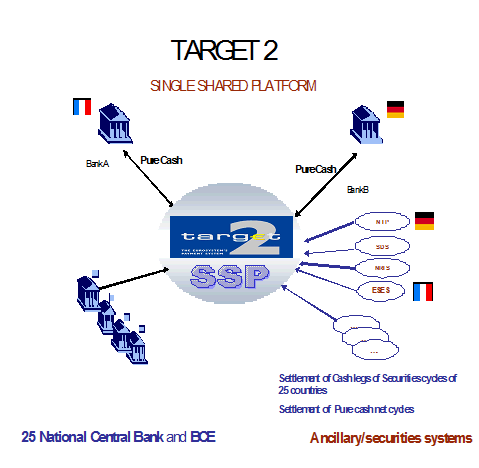
It is the Euro cash clearing system for gross settlement including cash and securities. It is a single shared platform (SSP) that replaces the previous local RTGS platforms (example: TBF in France and RTGS+ in Germany) and the cross border platform (Target 1).

It provides extensively harmonised Euro High Value Payments services via an integrated IT infrastructure. The payment orders are irrevocably posted, on a real time basis.

The ancillary systems are interfaced with Target 2 platform: the cash legs of the securities systems settle on Target 2 platform.


Overdraft Permitted

Overdrafts are not permitted.

Entitlements

Dividend Process

Most dividends are distributed according to ESES CSD records and are paid by the appointed issuers to the CSD participants within Euroclear , For shares registered in "Nominatif Pur" form, funds are directly received from the issuer (no impact on EOC's records).

Further to ESES implementation, entitlement is calculated form a trading perspective on Ex-date. The entitled position is calculated on  record date at COB. In this case, the buyer receives the entitlement:
Stock => if the position was traded

  • before the ex-date and
  • settled before or on the record-date

Flow (Market Claim) => if the position was traded

  • before the ex-date and
  • settled after the record-date


T2S Market Claims Process

Creation:

  • End of record date (RD) or immediately after matching during the market claim detection period
  • Market claims will be created with the same status of the underlying transaction (on "Hold" or "Released")
  • The Trade Date of the market claim will be the same as the trade date of the underlying transaction
  • The Intended Settlement Date (ISD) of the market claim will be equal to the payment date of income related events
  • The Intended Settlement Date (ISD) of the market claim will be on record date +1 business day for rights distribution events

Criteria

Status of settlement instruction: matched

Opt-out indicator: no or blank

Market claims will be created based on:

  • Intended Settlement Date (ISD) for securities registered in nominal (e.g. debt securities)
  • Ex-cum indicator or trade date for securities
  • On matched status of the underlying trade

Detection period

  • 20 business days after record date (RD)

Settlement

The settlement of market claim instructions will be independent from the settlement of the respective underlying transaction

The market claims instructions will attempt to settle:

  • In the night-time settlement period if generated at the end of RD in a "Released" status; instructions not settled will attempt to settle in the real-time settlement period
  • In the real-time settlement period if generated immediately after matching during the market claims detection period or when "released" by the participants if generated in "hold" status
Dividend Payment Frequency

In most cases annually. Some companies also make extraordinary payments.
It is the distributing company who decides on the frequency of dividend payments.

Interest Payment Frequency

Annually. The payment date (PD) is equal to the ex-date (only for bonds quoted in units), and usually the anniversary of the issuance.

Most bonds pay annually, although some pay semi-annually or quarterly.

All interest income are usually distributed by the appointed issuers agent through Euroclear  and paid to holders on PD. Euroclear  pays its participants on a gross basis.

Interest Accrual Rate

Actual/actual basis

The interest calculation method for money market instruments is actual/360 days.

Corporate Actions

Common Events:

The most common types of corporate actions are loyalty bonuses, dividends, rights issues, subscriptions, optional dividends, takeovers, mergers, warrant conversions, stock splits, redemptions in securities (not that common in French market), withdrawal of valueless securities.

Rights Tradable:

It depends on the type and terms of the corporate action. For example, rights are not tradable for optional dividends (Euronext), but they are tradable for subscriptions (OTC).

New Shares from Exercised Rights:

Some corporate actions, such as bonus issues or subscription via rights, may lead to the issuance of new shares. New shares do not always rank pari passu with the existing shares and are thus accounted under a different ISIN code. They are normally "assimilated" into the latter "parent code" after the following dividend payment.


Additional Information

In France, trade date determines entitlement to participate in the corporate action. Record date is always the day before ex-date. Consequently, the record date position is equal to a client's firm position at the close of business on ex-date +1.

Protection of Rights

Corporate actions on unsettled trades are automatically tracked in the ESES platform, which monitors trade and settlement dates for each transaction.

ESES automatically transfers the proceeds of the mandatory distribution from the seller to the buyer via market claims during 20 business days after. 

In case of failing trade in rights on deadline, a liability report can be initiated.

  • If it is an on-exchange trade, transfer of liability is managed directly by the CCP which can require the defaulting party to exercise the rights on behalf of the receiving party.
  • If it is an OTC trade generally the gentlemen's agreement applies. Transfer of liability is directly managed between you and your counterparty engaged in the failing transaction.

Proxy Voting

Foreign Investor Restrictions

Unrestricted voting rights.

Shares Blocked

No. Voting rights for bearer shares or registered shares held through a financial intermediary are established based on record date ("registration date") two business days prior to the meeting at start of business. The record date is be determined based on settled positions.

For bond meetings, the record date also applies.

Meeting Notices/Agendas

May be provided in English by major companies. 

General meetings are announced at least 35 calendar days prior to the meeting date itself.

Many of the companies listed on Euronext publish their announcement in the BALO thereby the meeting details are available from the following sources:

  • Euronext
  • Issuing company website
  • Euroclear France
  • The “Journal Officel”

Proposed resolutions are also published at that time. The announcement may also indicate the day and place of the meeting.

Meeting Outcome

Following the transposition of the European Shareholder Rights Directive (2007/36/EC) into French law, companies have the legal obligation to publish voting results on their websites within 15 calendar days of the meeting.

Company Reports

Not available.

Power of Attorney

Not required.

Other

Proxy Voting by Instrument Type

Equities

Fixed Income

Can Foreigners Vote by Proxy?

Yes

Not applicable

Proxy Card Returned to Issuer

Yes, in case of registered shares. If the shares are under bearer form, you have to returned the completed proxy card to the depositary agent

Not applicable

Vote Via Custodian/Representative

Not applicable

Not applicable

Typical Instruction Deadline

Not applicable, it is determined by the issuing company

Not applicable

Physical Presence Required

No

Not applicable

Re-Registration Required

No

Not applicable

English Agenda Supplied

Yes

Not applicable


Proxy Voting Restrictions
Voting can be exercised in person, by proxy or by mail. Electronic voting (if offered by the company) is possible in France To be noted that since 2003 it is allowed to vote thought electronic means via a dedicated website from the issuer, provided that such a facility is allowed by the Company's Statutes and the Board of Directors. In most cases, mail voting forms, which are printed by the company, are mandatory. 

Split voting is possible but only when using different proxy cards. Partial voting is allowed. 

The EU Shareholders Rights Directive:
The EU Shareholders Rights Directive 2007/36/EC, and the different transposition in the French law mainly in June and December 2010 aiming at harmonising General Meeting and proxy voting practices, came into force on January 1, 2011, the following changes to proxy voting processes have been implemented.

The main impacts of the Directive include: 

Articles L225-106 and L225-107 of the French Commercial Code:

  • A shareholder may be represented by another shareholder, by his or her spouse, or by his or her partner who he or she has entered into a civil union with.
    He or she can also be represented by an individual or legal entity of his or her choice:
  • When the shares are admitted to trading on a regulated market;
  • When the shares are admitted to trading on a multilateral trading facility which is subject to the legislative and regulatory provisions that protects investors against insider information, price manipulation, and dissemination of false information as provided by the general regulation of the Autorité des Marchés Financiers (French Financial Markets Regulatory Authority), included on a list issued by the AMF subject to the conditions provided by its general regulation, and stated in the company memorandum and articles of association.

Taxation

Dividend Tax Rate

25%

Foreign investors holding French securities are subject to withholding tax on the income deriving from these securities. Most of these foreign investors can nevertheless benefit from reduced withholding tax rates via the application of Double Taxation Treaties in place between France and their country of domicile, if the required tax documentation is provided in time. 

Central Banks, Sovereign Governments and Supranational Organisations, e.g. United Nations, are usually exempt from withholding tax on dividends and interest should the required tax documentation be provided in time.

The withholding tax rate of 30% decreased to 28% in 2020, 26.5% in 2021 and 25% in 2022.

Interest Tax Rate

In accordance with Article 187 of the FTC, corporate bonds issued before 1987 are subject to 15% WHT (10% before January 1, 2012) or 17% (12% before January 1, 2012). Such tax is levied at source by the issuer and applies to both French and non-resident investors. Below please find further details:

Instrument

WHT Rate

Government bonds

0%

Corporate bonds, issued after January 1, 1987

0%

Corporate bonds, issued before January 1, 1987

15%

Redeemable bonds by drawings and redemption premiums on bonds issued before January 1, 1986

17%

Until March 1 2010, interest payments derived from securities issued after October 1, 1984, and paid outside France, were subject to a 19% tax levy in France. Non-resident investors, however, were not subject to this tax provided that they were able to prove their non-residency.

Since March 1, 2010, interest has been largely exempted from the above-mentioned tax levy (exception: interest paid to residents of a Non-Cooperative State or Territory/NCST).

Capital Gains Tax Rate

Capital Gains Tax Rate

There is no capital gains tax withheld through RBC I&TS subcustodian on securities held in its books. Capital gains tax may however be payable on specific gains. RBC I&TS subcustodian does not assist in this regard. Please consult your tax advisor for further information


Tax Treaties

Albania

Iceland

Norway

Algeria

India

Oman

Andorra

Indonesia

Pakistan

Argentina

Iran

Panama

Armenia

Ireland

Philippines

Australia

Israel

Poland

Austria

Italy

Portugal

Azerbaijan

Ivory Coast

Qatar

Bahrain

Jamaica

Romania

Bangladesh

Japan

Russia

Belarus (ex USSR)

Jordan

Saint-Martin

Belgium

Kazakhstan

Saint-Pierre and Miquelon

Benin

Kenya

Saudi Arabia

Bolivia

Kirghizistan (ex USSR)

Senegal

Bosnia-Herzegovina (ex Yugoslavia)

Kuwait

Serbia (ex Yugoslavia)

Botswana

Latvia

Singapore

Brazil

Lebanon

Slovakia

Bulgaria

Libya

Slovenia

Burkina Faso

Lithuania

South Africa

Cameroon

Luxembourg

South Korea

Canada

Macedonia

Spain

Central African Republic

Madagascar

Sri Lanka

Chile

Malawi

Sweden

China

Malaysia

Switzerland

Congo

Mali

Syria

Croatia

Malta

Thailand

Cyprus

Mauritania

Togo

Czech Republic

Mauritius

Trinidad and Tobago

Ecuador

Mayotte

Tunisia

Egypt

Mexico

Turkey

Estonia

Moldavia (ex USSR)

Turkmenistan (ex USSR)

Ethiopia

Monaco

Ukraine

Finland

Mongolia

United Arab Emirates

French Polynesia

Montenegro (ex Yugoslavia)

United Kingdom

Gabon Republic

Morocco

United States of America

Georgia

Namibia

Uzbekistan

Germany

Netherlands

Venezuela

Ghana

New Caledonia

Vietnam

Greece

New Zealand

Zambia

Guinea

Niger

Zimbabwe

Hong Kong

Nigeria

Hungary


Stamp Duty

Effective January 1, 2008, transactions on French securities are exempt from stamp duty. This rule applies both to trades using the normal settlement cycle (T+2) and those executed via the Deferred Settlement Service (SRD). Stamp duty is not applicable to non-residents. 

Other Taxes

Financial Transaction Tax (FTT) : this measure was definitively approved by the French Parliament on the February 29, 2012 The effective date was August 1, 2012 with a rate of 0.2% and applies on any onerous acquisition of French shares listed in domestic, European and /or foreign markets where this acquisition generates a transfer of property. The FTT rate has increased to 0.3% with effect from January 1, 2017. All the details are provided in all corresponding Market Update and Client Update communication.

The tax applies when an acquisition results in a transfer of ownership (“acquisition à titre onereux”) and are taxable upon transfer of ownership:

  • No matter where the transaction was negotiated (e.g. Regulated Market, Multilateral Trading Facility (MTF), darkpool, OTC, internalisation, crossing network).
  • Whether the transaction has been executed by the Accountable Party for its own account or for an investor order.
  • No matter where the transaction settles (French CSD, foreign CSD).
  • Regardless of the investor’s tax residency.

The tax is applicable based on settlement date (legal transfer of ownership). It is assessed on the basis of the net buying position with regards to intra-day transactions per liable taxpayer, per security, per final purchaser.

Intra-day transactions are subject to the tax on the resulting net buying position at the end of the day and deferred settlement service (SRD) transactions at the end of the monthly liquidation period.

Exempt transactions must be reported. There are nine current exemptions:

  • Purchases linked to an issue of securities (primary market)
  • Purchases made by a clearing house or a central securities depository as part of their regular activities
  • Purchases linked to market making activities
  • Purchases linked to a liquidity contract
  • Intra-group transactions
  • Securities lending and repos
  • Acquisitions by employee mutual funds, employee open-ended investment funds or by employees directly
  • Acquisitions (including purchase of company shares) for employee saving schemes
  • Acquisitions of bonds that can be exchanged for or converted into shares

The tax is assessed on the buyer and is collected by the Investment Service Provider (ISP) or Broker who has executed the transaction on behalf of its investors or by the custodian of the end investor when there is no ISP in the chain.

Holiday Calendar

FRANCE Holiday Calendar

Local Websites